Introductions & Overviews
Welcome to IS310 - Culture As Data Fall 2026
Who are your instructors?
Lead Instructor: Dr. Zoe LeBlanc (You can call me Prof. LeBlanc or Prof. Zoe)
Pronouns: She/Her
Email: zleblanc@illinois.edu
Website: zoeleblanc.com
Contact me via Slack please I will try to learn your names starting next week. Please correct me if I get it wrong. Thank you!!
Who are your instructors?
Only for section B
Teaching Assistant: Jessica Frye (Prefers Jess)
Pronouns: She/Her
Email: jrfrye2@illinois.edu

Who are your instructors?
You might also occasionally see my boss, Nenya.

Please Introduce Yourself
In the Zoom chat, please share the following:
- Your name and pronouns, if you would like
- Your major, year, and any relevant experience
- What you hope to learn in this course
Bonus: feel free to share adorable pet pics!
Today’s Plan
- Review the syllabus and course website
- Complete the first-day survey
- Start setting up course tools
- Identify setup questions for Thursday
Course Description
Currently the iSchool catalogue lists this following course description:
Explores use and application of technology to scholarly activity in the humanities, including projects that put classic texts on the web or create multimedia applications on humanities topics.
This isn’t necessarily wrong, but not quite descriptive enough for this version of the course.
What is “Culture as Data”?
Our goal is to understand how culture can be represented as data and studied with computation.
By culture, we mean what’s usually associated with the Humanities:
- Popular fiction & literature
- Newspapers & government documents
- Online communities (Reddit, TikTok subcultures)
Culture is Increasingly Digital
Culture is an intrinsic part of being human.
Today, that culture is increasingly both digital and datafied.
But representing our cultural heritage is rarely straightforward or without tradeoffs.
Humanities Can Change Computing
We will explore how humanities can change how we think about computing.
- Histories of data collection and computation are fundamentally political
- Interpretation becomes “baked” into technologies
- These forces shape both scholarship and society
What We’ll Do
We will investigate these topics through:
- Weekly readings and assignments
- A semester-long project
- Experiencing the full process: from cultural topic → creating data → auditing data → documenting and sharing findings
Some of Our Bigger Questions
Across readings, datasets, coding assignments, and projects, we will ask:
- What happens when culture becomes data?
- Who decides what gets collected, categorized, preserved, or ignored?
- How do data structures shape cultural interpretation?
- What can computation help us see, and what does it flatten or miss?
- How can we document cultural data so others can understand, reuse, and question it?
What Comes After This Course?
Much depends on your interests, but you will be well equipped to continue undertaking substantive and innovative research on culture using computation and data. These skills are useful whether you aim to be a:
- Data scientist or developer
- Computational or Data Journalist
- Data or DH Librarian
- HCI or UX researcher
Or just someone who understands how technology and information shape our world
Ideally…
I hope each of you continues to work on your final project and share your research long after the course ends.
Prerequisites
Pre- and Co-Requisites
There is no required prerequisite.
However, students should have some previous experience equivalent to a semester of programming, ideally in Python.
Relevant courses include IS205 and IS107.
How much coding experience?
I get this question every semester and there is no one answer. Part of the reason it depends is because AI is revolutionizing how we code. So even if you have limited experience, you might actually get further than you expect.
However, I would say that if you have limited interest in coding, please talk with the instructors early so we can help you understand the workload and decide what support makes sense.
Questions?
Interested students should contact the instructor if they have any questions.
Let’s get started!
By exploring our course website ✨
Assessments
In this course, we have two main categories of assessments: weekly ones and ones associated with the semester long project. Both types are intended to introduce you to new materials, help you synthesize this content, and engage in research that is meaningful to you. Your final grade will be evenly divided between these two categories.
Weekly Assessments
Your performance in weekly assessments constitutes half of your final grade.
Full details: Weekly Assessments
| Component | Weight |
|---|---|
| Weekly Participation | 25% |
| Weekly Coding Assignments | 25% |
| Total | 50% |
Weekly Rhythm
- Before Tuesday: read and explore assigned materials
- Tuesday: discuss readings and cultural data examples
- Before Thursday: work through the technical lesson and submit coding assignments
- Thursday: review, troubleshoot, and work in breakout groups
Not every week will follow this plan exactly, but the goal is try to have a combination of critical thinking and building each week.
Weekly Participation (25%)
Each class meeting gives you a chance to earn participation credit.
| Score | Requirement |
|---|---|
| 2 | Prepared + contributed |
| 1 | Prepared or contributed |
| 0 | No visible participation |
What Counts as Prepared?
For more seminar discussion days:
- Complete the assigned materials
- Add short Hypothesis annotations before class
- Bring a question, connection, or concern
For more technical instruction days:
- Read or try the assigned lesson before class
- Use Hypothesis to flag questions, bugs, or confusing steps
- Bring a code question, GitHub commit, bug report, or demo
Generally, the goal is to reserve class time for discussing either interpretative problems or technical challenges.
What Counts as Contributed?
Contribution means helping the class think, troubleshoot, or collaborate.
- Speaking during seminar
- Using Zoom chat substantively
- Responding to classmates
- Helping your group make sense of a reading, dataset, or activity
Strong participation can look different for different students.
Technical Participation Counts Too
Technical work is also part of your weekly participation opportunities. What counts?
- Asking a question during technical review
- Demoing your code, bug, output, or workflow
- Helping a peer troubleshoot during work time
- Connecting the technical lesson to your project
Key point: Attendance alone is not full participation.
Group Labs and Collaboration
Groups will be assigned within the first two weeks of class after an initial survey of student interests and backgrounds. This group will work together to complete active in-class activities and occasional out-of-class assignments, which will be documented and submitted via GitHub, as well as collaborate on the semester-long project.
On group lab days, your lab work counts as the contributed part of participation. To receive full participation credit for the day, you still need both preparation and a visible contribution to the group lab, live discussion, or Zoom chat.
Structure and Expectations
What does this look like in practice? Across the semester, your group will be expected to do a combination of the following:
- Weekly prompts and activities
- In-class synthesis
- Documentation and submission to GitHub
- Working on your semester-long project
Grading will be based on your active participation in presentations, the quality of your contributions, and the effectiveness of your collaboration. Weekly group work must be submitted to GitHub by midnight prior to the class when it is due. This ensures that the work is available for review and that all group members are accountable for their contributions.
Weekly Coding Assignments (25%)
Weekly coding assignments help you practice technical material and connect it to your project.
- Submit through GitHub
- Pair programming is encouraged
- You are responsible for understanding your own submission
Coding Assignment Scale
| Score | Requirement |
|---|---|
| 2 | Complete assignment |
| 1 | Partial completion |
| 0 | Missing or insufficient assignment |
The goal is practice, process, and understanding.
AI Chat Log Note
Some coding assignments will ask for ai-chat-log.md.
If you used AI, document:
- What you asked for help with
- Relevant prompts and chatbot responses
- What you accepted, rejected, revised, tested, or checked
- What you still do not understand
Do not include private data, passwords, API keys, or unrelated chatbot conversation.
Required Texts & Resources
Good news: Almost all materials available free online!
- Course website
- Canvas
No required purchases for software or books.
Computer Access
You will need access to a computer.
If this is an issue, let me know early — we’ll find solutions!
Summary
| Component | Weight |
|---|---|
| Weekly Participation | 25% |
| Weekly Coding Assignments | 25% |
| Total | 50% |
Questions?
Remember:
- Engage thoughtfully
- Collaborate with peers
- Ask questions early and often!
Semester Long Project
The goal of this project is to expose you to how we create, uncover, document, and share culture as data.
You will be assessed on both your individual data work and your group’s collective website and repository.
Full details: Semester Long Project
Inspired by RDC Project
The project is modeled on the Responsible Datasets in Context Project:
responsible-datasets-in-context.com
Created to help students “work with data responsibly.”
Why Context Matters
“Data cannot be analyzed responsibly without deep knowledge of its social and historical context, provenance, and limitations.”
“In classes, it is very common for students to use datasets that they find on websites like Kaggle, datasets that are poorly documented and that students thus don’t fully understand. This is a recipe for irresponsible data work.”
Your Goal
You will work with culture as data through two connected approaches.
- Creating culture as data
- Auditing existing culture as data
The Evidence
Both approaches must be grounded in evidence:
- The dataset itself
- Computational process
- Documentation
- GitHub history
- Scholarly citations
AI can help, but it cannot replace the friction of making decisions, checking sources, testing code, documenting uncertainty, and explaining how the dataset came to be.
Required Transformations
For your custom dataset, make visible at least two steps:
- Cultural materials → working representation
- Working representation → structured data
Project Milestones
Timeline Overview
| Milestone | Due | Extension | Weight |
|---|---|---|---|
| Proposal: Collective Focus + Individual Plan | Sep 15 | Sep 22 | Pass/Fail |
| Initial Custom Dataset and Audit Plan | Oct 20 | Oct 27 | 15% |
| Final Group Presentation | Dec 8 | None | 5% |
| Final Project Submission | Dec 11 | Dec 18 | 30% |
Milestone 1: Collective & Individual Topic Selection
DUE TUESDAY, SEPTEMBER 15, 2026
(Automatic extension available until September 22)
Group Formation
In the first two weeks, you will be assigned to a group based on:
- Shared interests
- Complementary skill sets
Planning Document
Your first task is to collaboratively determine:
- Group Theme: shared area of interest and scope
- Individual Ideas: possible datasets for each member
- Scholarly Context: scholarship that helps explain the topic
- Collaboration Plan: communication, GitHub, and website organization
Format & Submission
- Markdown file, such as
planning.md, in your group GitHub repository - 500–750 words
- Use headings, bullet points, links, images, or tables
- Include scholarly citations
Milestone 2: Initial Custom Dataset and Audit Plan
DUE TUESDAY, OCTOBER 20, 2026
(Automatic extension available until October 27)
15% of Final Grade
Details available here: Milestone 2
Why Start Small?
Create an initial custom dataset of roughly 50–100 items.
The goal is to experience what it means to make data carefully:
- item by item
- decision by decision
- category by category
Computation Required
You are required to use computational tools to assist your custom dataset.
This is not only about automation.
It is about understanding how computation can structure, check, compare, visualize, question, or document cultural data.
Submission Components
- Initial Custom Dataset
- Initial Documentation
- Computational Process
- Audit and Connection Plan
- Reflection + Scholarly Citations
Milestone 3: Final Group Presentation
TUESDAY, DECEMBER 8, 2026
5% of Final Grade
Presentation Focus
Each group briefly presents its website and collective principles.
Focus on:
- What your group learned about its shared cultural data type
- How the website organizes the individual projects
- What principles emerged from the work
- What future researchers should know before reusing the datasets
You do not need to present every individual dataset in detail.
Making Labor Visible
The final presentation should also explain:
- How your group worked together
- How the website and repository are organized
- What GitHub history, contribution logs, or process documentation show
- What forms of labor were harder to capture
Milestone 4: Final Submission
DUE FRIDAY, DECEMBER 11, 2026
(Optional extension available until December 18)
30% of Final Grade
More details available here: Milestone 4
Final Submission Priorities
| Component | Who? | Weight |
|---|---|---|
| Culture As Documentation & Reflection | Individual | 12% |
| Culture As Custom & Audited Data | Individual | 12% |
| Collective Website and GitHub Repository | Collective | 6% |
Final Submission: Individual
Each student submits:
- Final structured dataset
- Computational audit, comparison, cleaning, or transformation
- GitHub documentation for reuse
- Process reflection
- Process page for the group website
- Scholarly citations
GitHub vs. Website
They do different work.
| GitHub Repository | Group Static Site Website |
|---|---|
| Documentation for reuse and preservation | Story of how the datasets came to be |
| Data, code, schemas, licenses | Process, choices, uncertainty, labor |
| Stable place to cite and download | Public explanation of group learning |
Final Submission: Group
Each group submits:
- Minimal-computing static site website
- Group overview
- Collective principles document
- Links to repository and individual datasets
- Individual dataset folders
CONTRIBUTIONS.mdor contribution section inREADME.md
Contribution Log
Your contribution log should show:
- Named responsibility for pages, documentation, review, or technical work
- Contributions to collective principles/documentation
- Peer review, editing, testing, or troubleshooting
- GitHub commits, issues, pull requests, or file history
Treat GitHub history as data about collaborative labor: what does it reveal, and what does it miss?
Think of It As…
Writing the documentation you wish had existed when you started.
- What should someone know before representing music as data? Or social media? Or gaming culture?
- What principles emerged from your group’s diverse approaches?
Summary
Grade Breakdown
| Component | Weight |
|---|---|
| Proposal: Collective Focus + Individual Plan | Pass/Fail |
| Initial Custom Dataset and Audit Plan | 15% |
| Final Group Presentation | 5% |
| Final Project Submission | 30% |
| Total | 50% |
Questions?
Remember:
- Create culture as data
- Audit existing culture as data
- Use computation to support, not replace
- Document decisions, labor, uncertainty, and limits
- Situate the work in scholarship
More details throughout the semester. Requirements may shift depending on the pace of the course and the needs of the projects.
General Note on Grading
I tend to use GitHub to have as much transparency when it comes to grading and feedback.
Generally, as far as I’m concerned you are all A+ humans. It’s just about ensuring that effort, creativity, labor, and other core principles are correctly evaluated. If you have concerns over grades, I am always happy to discuss them.
Course Policies
Also available on the course website
Attendance
The iSchool expects students to attend all classes except in cases of emergency. Student Code on Attendance: http://studentcode.illinois.edu/article1/part5/1-501/
This course meets on Zoom, and synchronous attendance matters for discussion, technical practice, group collaboration, and shared troubleshooting.
Attendance is not a separate grade category, but each class meeting is an opportunity to earn Weekly Participation credit.
Zoom Participation
You are not required to turn your camera on, but it is appreciated.
You are expected to stay respectfully engaged through some combination of:
- video or audio
- Zoom chat
- collaborative documents
- group work
- screen sharing during technical work
Zoom Recordings
Class meetings on Zoom will be recorded.
Access to recordings is not automatic and is not meant to replace synchronous participation.
Recordings will only be made available to students with Instructor approval and a reason for missing class.
If You Need to Miss Class
If you are feeling unwell, have an emergency, or have a serious conflict, please prioritize your health and responsibilities.
I do not require doctor’s notes for absences.
However, please keep in mind that if you miss a substantial portion of class meetings, it will be difficult to make up missed content and that you need to coordinate with your group members who depend on your contributions.
When You Miss Class
- Message me on Slack as soon as possible
- Inform your group members so they can plan accordingly
- Check in with me about making up missed content
- Review materials on the course website
Missing class without communicating usually means 0 participation for that meeting.
Information Overload Days
Sometimes you need a break from the workload.
Instead of missing class outright, let me know you need an information overload day.
How Information Overload Days Work
- You are excused from assigned materials and discussion
- You actively listen during class
- Consult with instructor about make-up assignments later
- Inform your group and help them adjust
Two free, no questions asked — after that, let’s talk!
Worst Case Scenarios
If you or someone close to you becomes ill:
- Final grade based on existing work
- Option to move course to pass/fail
When you can, please get in touch. Your wellbeing comes first.
Communication & Respect
We use Slack for communication beyond class meetings.
- Join the DH@UIUC Slack (link in Canvas)
- Join the
#is310-fall-2026channel
You can also use Calendly or email zleblanc@illinois.edu.
Respect in All Communication
- Zoom and breakout room interactions
- Slack messages
- Emails
This course is experimental with students from varied backgrounds. Every opinion, question, and idea deserves a respectful response.
Rule of Thumb
When in doubt, ask questions and over-communicate — but do so respectfully!
Academic and Self Integrity
The iSchool maintains academic integrity to protect the quality of education.
Consequences range from written warnings to failing grades or dismissal.
The Short Version
Don’t cheat.
If you need help, see the instructor.
I would rather you turn in work late than have to report you for plagiarism.
Citation as Practice
We’ll discuss what constitutes plagiarism (it gets thorny with code).
Rule of thumb: Cite as much as possible.
All scholarship is a collective endeavor.
Why Citation Matters
“Citation is how we acknowledge our debt to those who came before; those who helped us find our way when the way was obscured because we deviated from the paths we were told to follow.”
— Sara Ahmed, Living a Feminist Life
“Acknowledging and establishing feminist genealogies is part of the work of producing more just forms of knowledge and intellectual practice.”
— Beverly Weber, Digital Feminist Collective
Why Citation Matters
Acknowledging sources is both intellectually and politically imperative.
AI Policy
This course explicitly allows AI tools.
We will experiment with GitHub Copilot and other options throughout the semester.
AI is not going away, so we need to engage with it critically and document how it shapes our work.
Your AI Workflow
In the first two weeks, submit an initial file explaining your preferred workflow for the course.
- Using AI? Which tools? For what purposes?
- Not using AI? What’s your alternative workflow?
- Using local models? Consult with instructor for setup.
Assignment AI Chat Log Notes
Coding assignments will ask you to include an ai-chat-log.md file in the assignment folder if you are using AI. Details are available in the AI chat log expectations.
When required, include a record of the relevant chatbot conversation:
- Prompts you wrote
- AI responses that shaped your work
- Exchanges where you asked for help, debugged, revised, tested, or learned something
The file should be more than a summary, but it does not need unrelated chatter or every failed detour.
If Your Workflow Changes
AI use is iterative and experimental.
If your approach changes during the semester, simply update your Init IS310 file.
No judgment: experimentation is encouraged.
AI Access & Equity
We will primarily use tools that are free of charge:
- GitHub Copilot (free with GitHub Student Developer Pack)
- Open-source local models, with setup guidance available
If using paid tools, disclose and check for education discounts.
AI for Coding
You may use AI to help write, debug, and understand code.
But make sure you understand what the code does.
If code breaks, you need to fix it.
AI for Written Work
You may use AI for brainstorming, outlining, drafting, or editing.
Your ideas, arguments, and voice should be yours.
If an essay reads like it was primarily AI-generated, you will be dinged points.
AI for Data Work
You may use AI for data collection, cleaning, analysis, or documentation.
You make the interpretive decisions.
Your work must demonstrate you understand your methodology deeply.
AI Academic Integrity
Using AI is not cheating in this course.
However, plagiarism is still plagiarism.
Do not submit work generated by others, human or AI, as if it is entirely your own intellectual contribution.
If AI generates incorrect information or problematic code, you are responsible for catching and fixing it.
The Bottom Line
AI should make you more capable, not less thoughtful.
It should amplify your learning, not replace it.
If you can’t explain what your code does or why your writing makes certain arguments, stop and reassess.
Questions?
If you have concerns, questions about what is allowed, or uncertainty about whether your approach is appropriate, please ask.
There are no wrong questions about AI as we are all figuring this out together.
Example Citation?
When using AI tools like Codex, cite them as you would software:
OpenAI. (2026). Codex [AI coding assistant]. https://openai.com/codex
Or in prose: “These slides were created with assistance from Codex (OpenAI, 2026), an AI coding assistant used for formatting Quarto/Reveal.js syntax.”
Questions?
Remember:
- Communicate early and often
- Engage thoughtfully with AI
- Respect each other and the instructors
Full policies available on the course website.
Land Acknowledgement Statement
Adopted by the University of Illinois in 2018
I would like to begin today by recognizing and acknowledging that we are on the lands of the Peoria, Kaskaskia, Piankashaw, Wea, Miami, Mascoutin, Odawa, Sauk, Mesquaki, Kickapoo, Potawatomi, Ojibwe, and Chickasaw Nations.
Traditional Territory
These lands were the traditional territory of these Native Nations prior to their forced removal;
These lands continue to carry the stories of these Nations and their struggles for survival and identity.
Our Responsibility
As a land-grant institution, the University of Illinois has a particular responsibility to acknowledge the peoples of these lands, as well as the histories of dispossession that have allowed for the growth of this institution for the past 150 years. We are also obligated to reflect on and actively address these histories and the role that this university has played in shaping them. This acknowledgement and the centering of Native peoples is a start as we move forward for the next 150 years.
Beyond Platitudes: What does this mean?
While this acknowledgement is important, I find that these words can be difficult to understand or visualize.
Let’s look at two cultural data projects that help us understand.
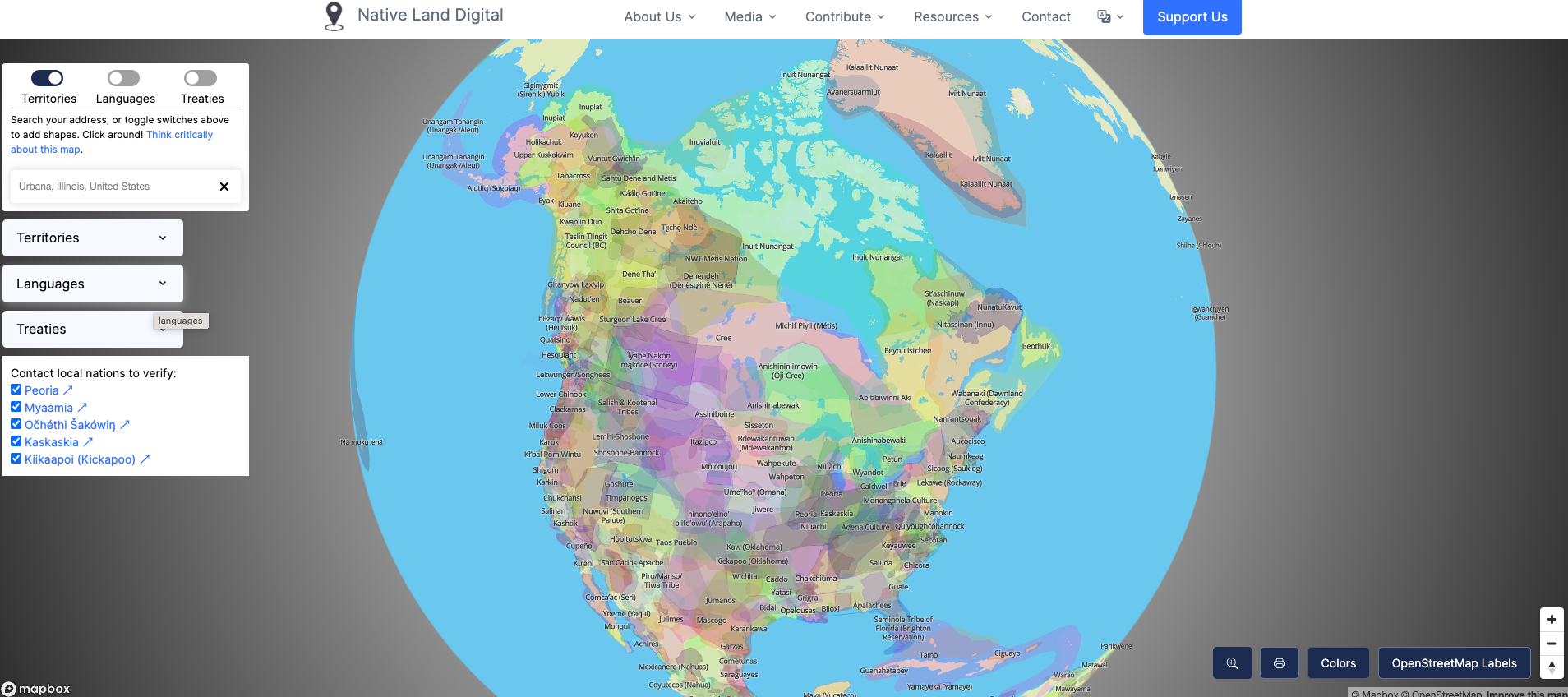
Native Land Digital
Visualizes indigenous lands worldwide, built by a Canadian non-for-profit, that helps us see how this dispossession has shaped our very understanding of geography and political identity.
Native Land Digital
Land Grab Universities
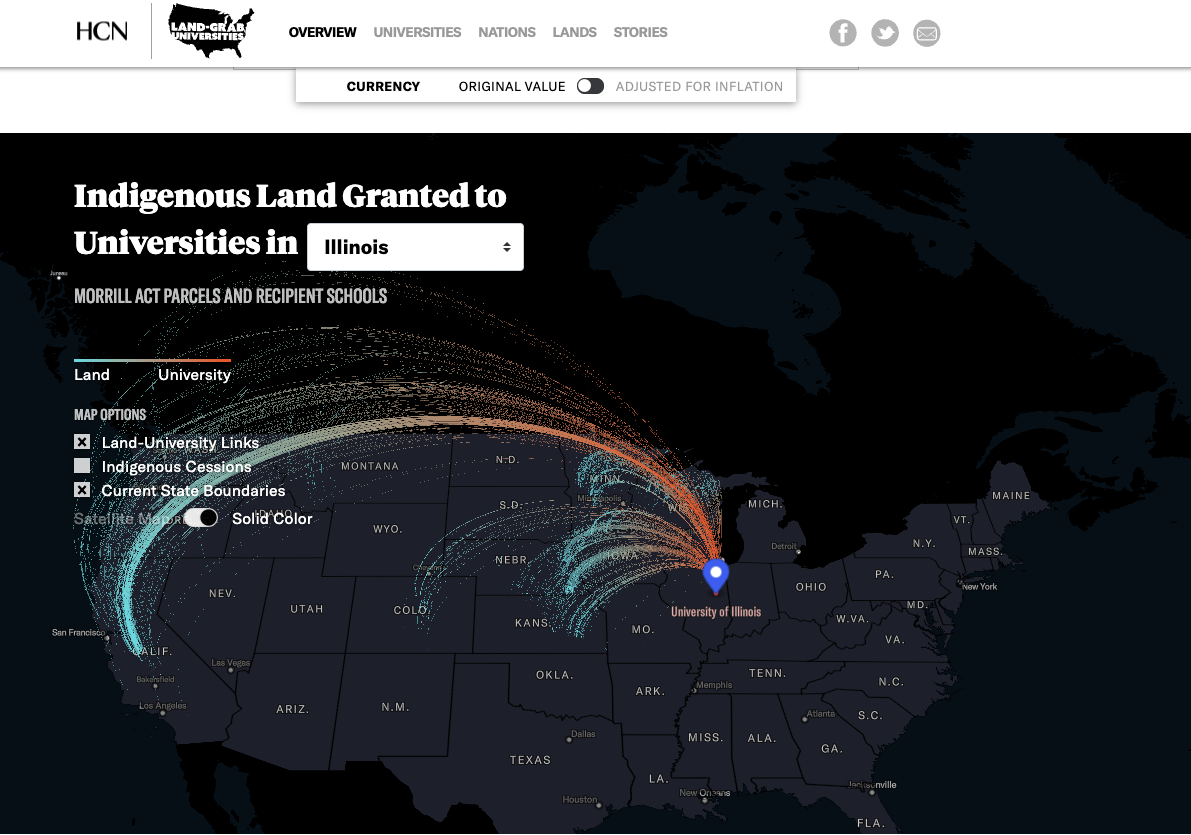
How the Morrill Act dispossessed tribal lands, signed in 1862, dispossessed tribal lands to fund the creation of public state universities. The project was built by Robert Lee, Tristane Ahtone, Margaret Pearce, Kalen Goodluck, Geoff McGhee, and Cody Leff and published by High Country News
Land Grab Universities
First-Day Survey
Please complete the first-day survey linked in Canvas.
This helps me:
- Form groups around shared interests
- Understand coding and data experience
- Identify access or setup concerns
- Learn what you hope to get from the course
Please contact me if you cannot access the survey.
Course Tools
If we have time today, we will start the first course tools lesson.
Tool Setup Priorities
Focus first on:
- Slack
- Hypothesis
- GitHub
- AI tool of your choice (Recommend Copilot via GitHub Education Benefits)
- VS Code
Bring setup problems to Thursday.
Before Thursday
- Finish the first-day survey
- Join Slack and Hypothesis
- Create or update your GitHub account
- Start the course tools lesson
- Note where you get stuck