Programming & Processing

How will we work in this class, and how are new technologies changing those workflows?

Any Questions About Course Tools?

https://cultureasdata-uiuc.github.io/is310-fall-2026/materials/introducing-defining-cad/01-CAD-tools.html

Initial Interest Survey Check

As of this morning:

Section Completed Current Students
A 12 23
B 9 26
Total 21 49

28 current students still need to complete the survey. Please complete this ASAP so I can start forming groups for Tuesday’s class. Link is on Canvas and please reach out if you have any issues accessing it.

Reminder: These Are Required

Reminder: These Are Optional

Any Python Issues?

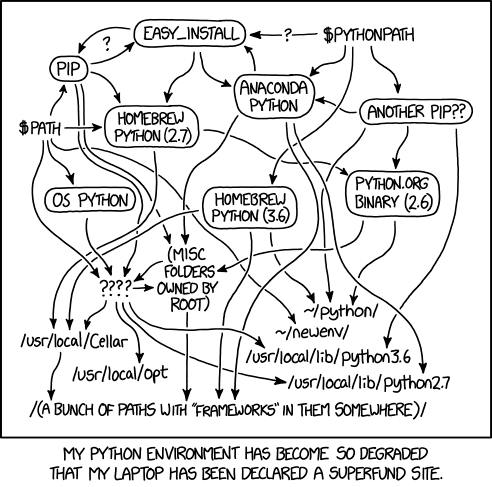
Python Environment by Russell Monroe

Reminder: Modern Software Is A Problem

The best representation of what I’m talking about is this xkcd comic, entitled Dependency.
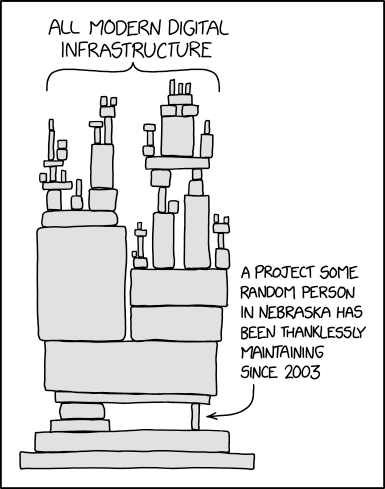
Dependency by Randall Munroe

Hypothesis Demo

Let’s Annotate the Data Labor Reading

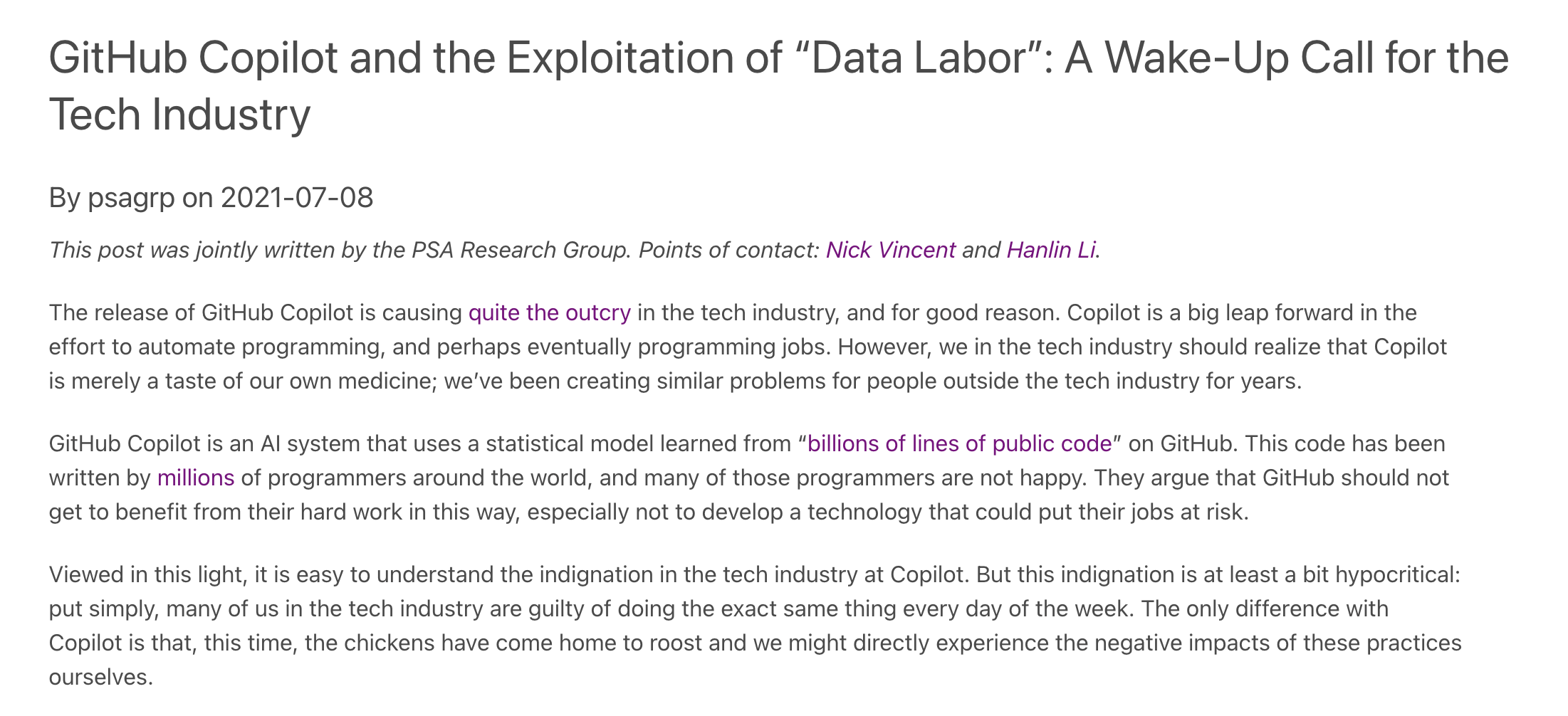
Vincent and Li, “GitHub Copilot and the Exploitation of ‘Data Labor’”

Today we are practicing how to:

  • Open Hypothesis on a reading
  • Make sure we are posting to our course group
  • Highlight a passage that matters
  • Add a question, connection, or concern

Turn On Hypothesis

Activating Hypothesis in Chrome

Activating Hypothesis in Firefox

If you have yet to install or sign up for Hypothesis, please follow the quick start guide that is linked in our course materials https://cultureasdata-uiuc.github.io/is310-fall-2026/materials/introducing-defining-cad/01-CAD-tools.html#hypothesis.

Open the Sidebar

Hypothesis Sidebar

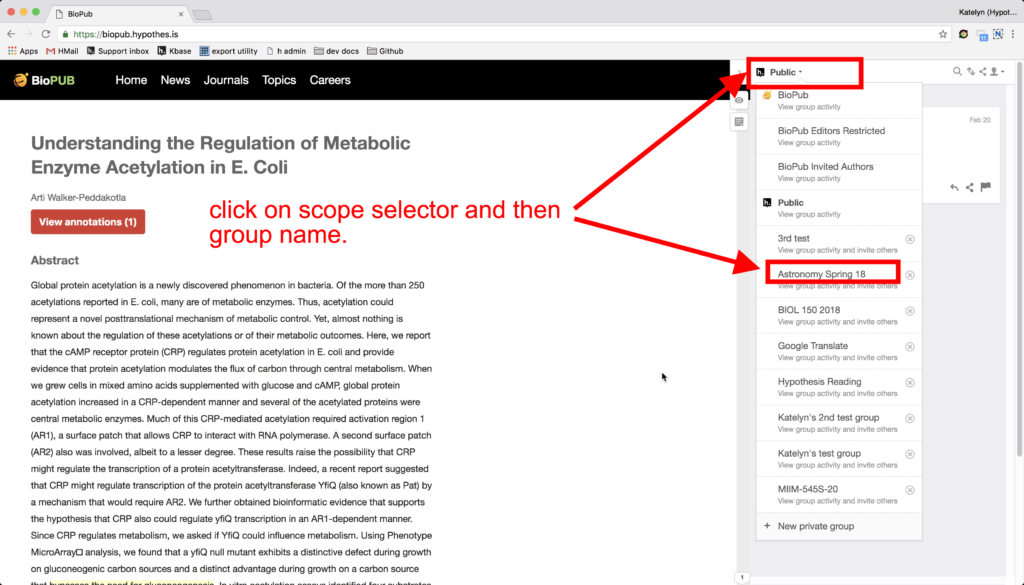
Annotate From Our Group

Hypothesis Group Selector

What Should You Annotate?

For assigned readings, add two annotations by midnight before class:

  1. One passage you think matters.
  2. One question, connection, or concern.

Your annotations should help us start discussion, not summarize everything.

What about PDFs? Let’s Try Annotating Next Week’s Reading

Open next week’s Manovich reading from Canvas:

Lev Manovich, “Types of Cultural Data”

Please follow the instructions here https://cultureasdata-uiuc.github.io/is310-fall-2026/materials/introducing-defining-cad/01-CAD-tools.html#using-hypothesis-on-local-pdfs to annotate a local PDF.

Hypothesis Annotations Moving Forward

  • As a reminder, you need to make two annotations per reading by midnight before class for full credit.
  • If your annotations are late, you will receive half credit unless you get approval from the instructor.
  • You may be asked about your annotations in class, so please use them as a chance to highlight questions or connections you want to discuss.

Let’s Discuss Our Readings

Two readings assigned for today:

Let’s Start with GitHub Copilot and Data Labor
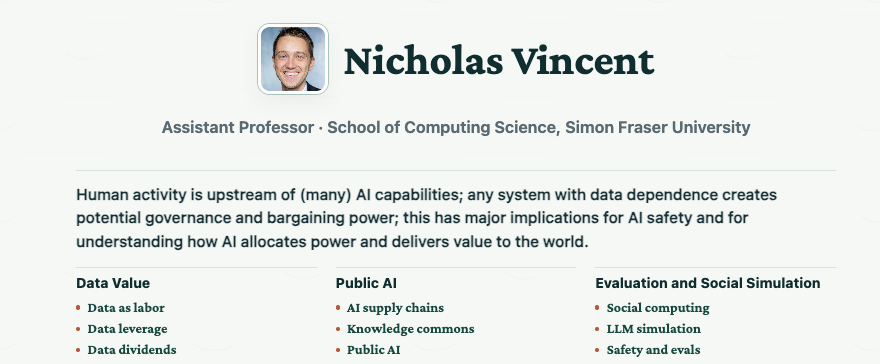
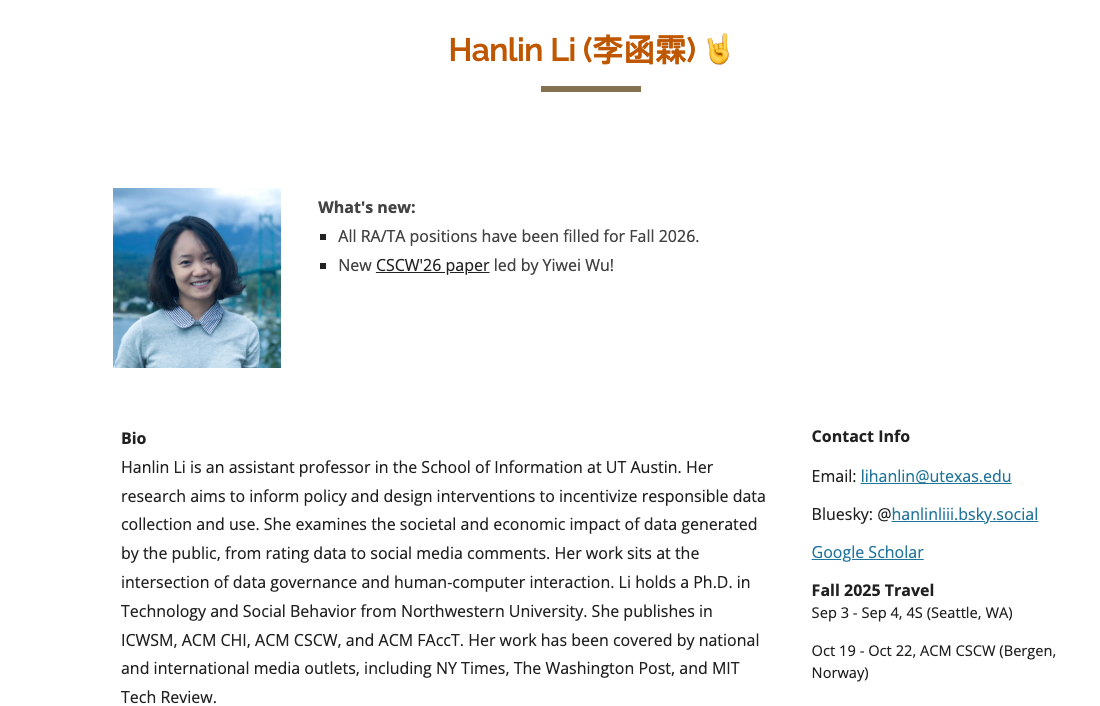
Who are the authors & is this scholarship?
What are their critiques of GitHub? What is Data Labor?

100 million users

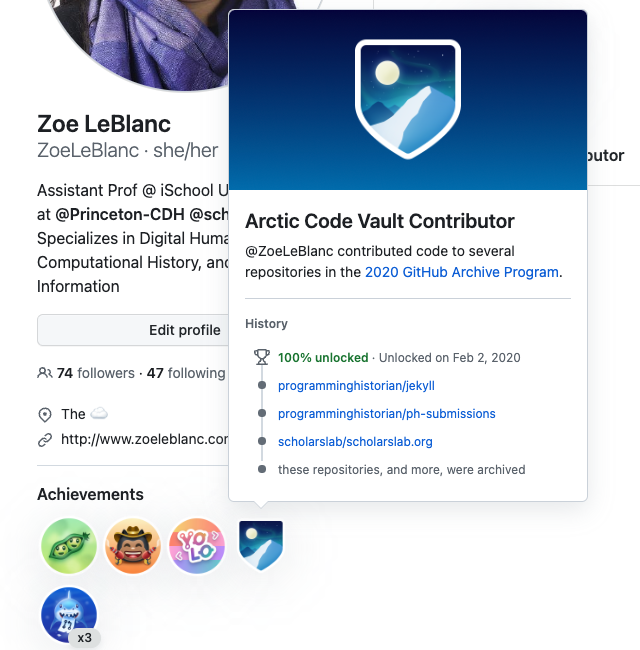
GitHub Arctic Code Vault

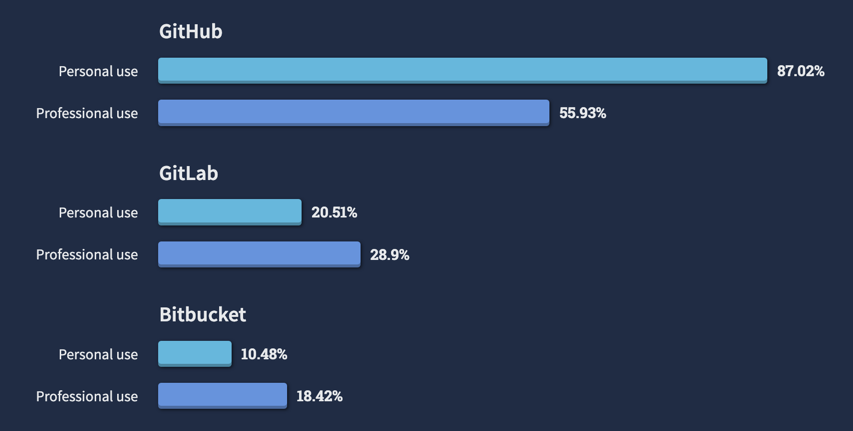
Should we not use GitHub? Alternatives to GitHub

Let’s Connect to Models All the Way Down

Jer Thorp & Christo Buschek, Knowing Machines (2024)

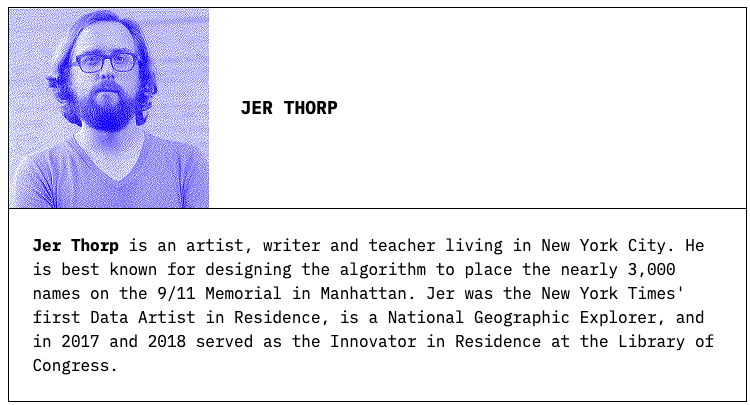
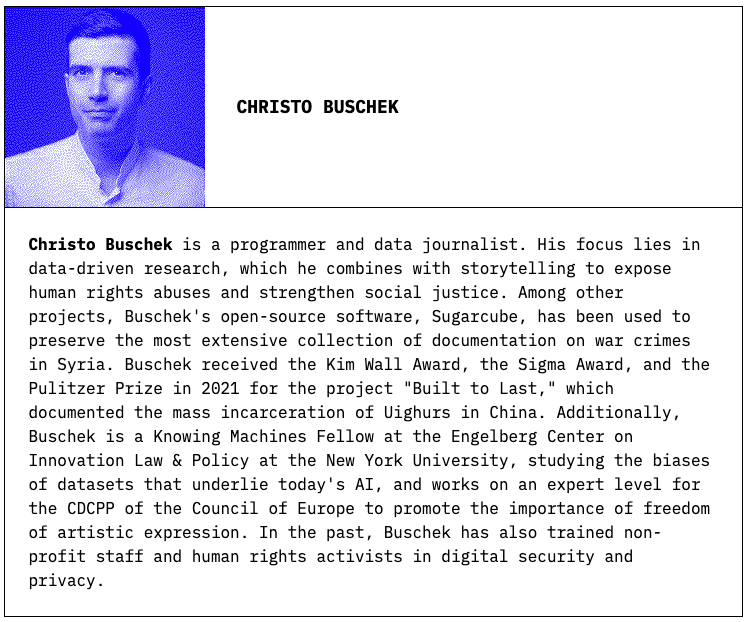
Who are the authors & is this scholarship?
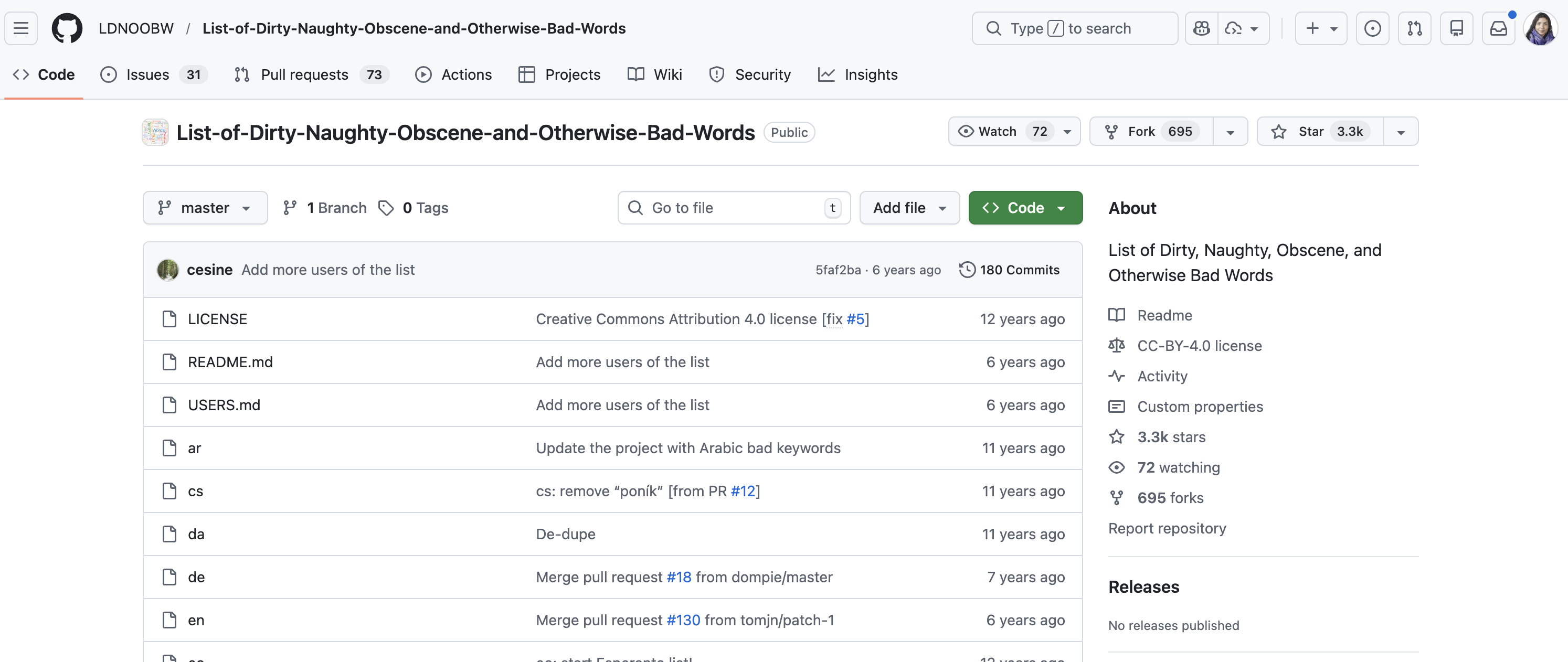
What is LAION-5B?

How was LAION-5B Built?

What is in Common Crawl?

Schaul, Kevin, Szu Yu Chen, and Nitasha Tiku. “Inside the Secret List of Websites That Make AI like ChatGPT Sound Smart.” Washington Post, April 19, 2023.

About Me

Lucy, Li, Suchin Gururangan, Luca Soldaini, et al. “AboutMe: Using Self-Descriptions in Webpages to Document the Effects of English Pretraining Data Filters.” arXiv:2401.06408. Preprint, arXiv, January 12, 2024. https://doi.org/10.48550/arXiv.2401.06408.

About Me

What is seeing like an algorithm?
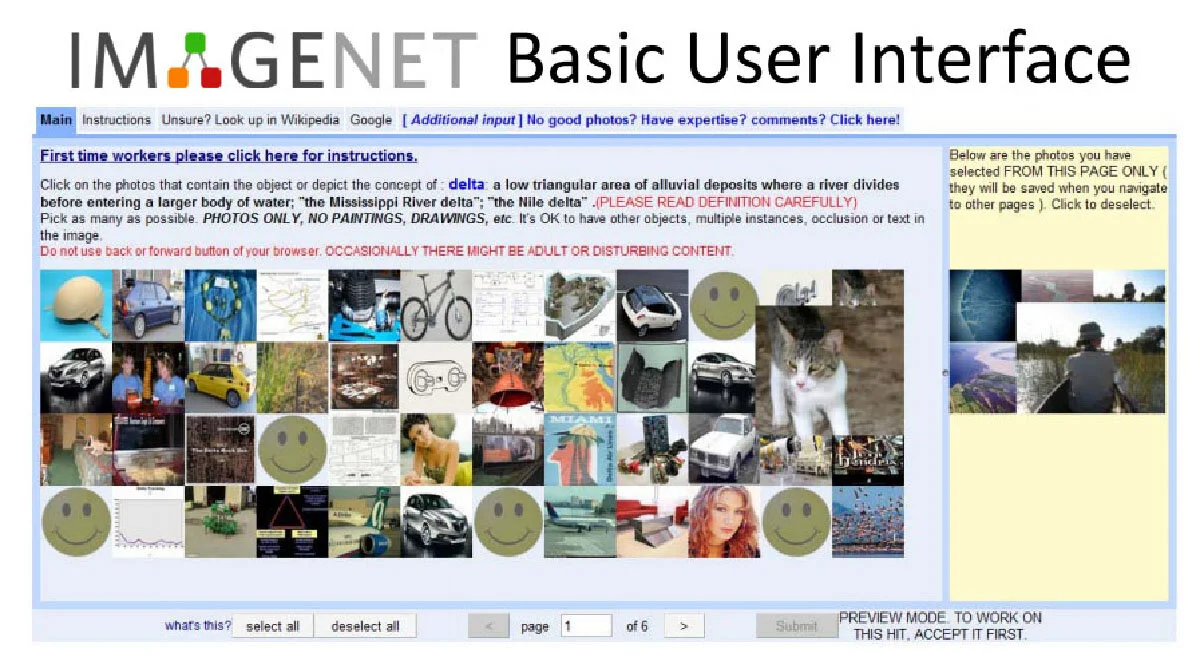
Excavating AI

The Politics of Images in Machine Learning Training Sets

By Kate Crawford and Trevor Paglen

Why Models All the Way Down? What is the Circularity Problem?

“There are models on top of models, and training sets on top of training sets.”

“Omissions and biases and blind spots from these stacked-up models and training sets shape all of the resulting new models and new training sets.”

What are the problems with this data?

Why is scale a problem?

The Problem: In December 2023, researchers found over 1,000 images of Child Sexual Abuse Material (CSAM) in the dataset

How are these datsets “curated”?

Curation by Statistics

“The tiniest of shifts in LAION’s thresholds could have excluded or included hundreds of millions of images

  • 16% of images are within 0.01 of the lower threshold
  • Raising the threshold by just 0.01 would remove 937 million image pairs

Whose Images?

For every English speaker: 1.6 image captions

For every French speaker: 0.5 image captions

For every Swahili speaker: 0.03 image captions

“For models trained on LAION-5B, English (and English-speaking culture) is valued more than the other 107 languages combined.”

Whose Aesthetics?

“The concepts of what is and isn’t visually appealing can be influenced in outsized ways by the tastes of a very small group of individuals

Midjourney’s aesthetic fine-tuning: shaped by a handful of Discord users and a 65-year-old mechanical engineer from Wisconsin

What does this mean for how we use AI?

  • What sorts of use cases are appropriate for AI?
  • What dangers exist because of the reliance on training data?
  • Do we understand the difference between and LLM and a chatbot? hint: models all the way down!

Time To Prompt: The Command Line

What is a Terminal?

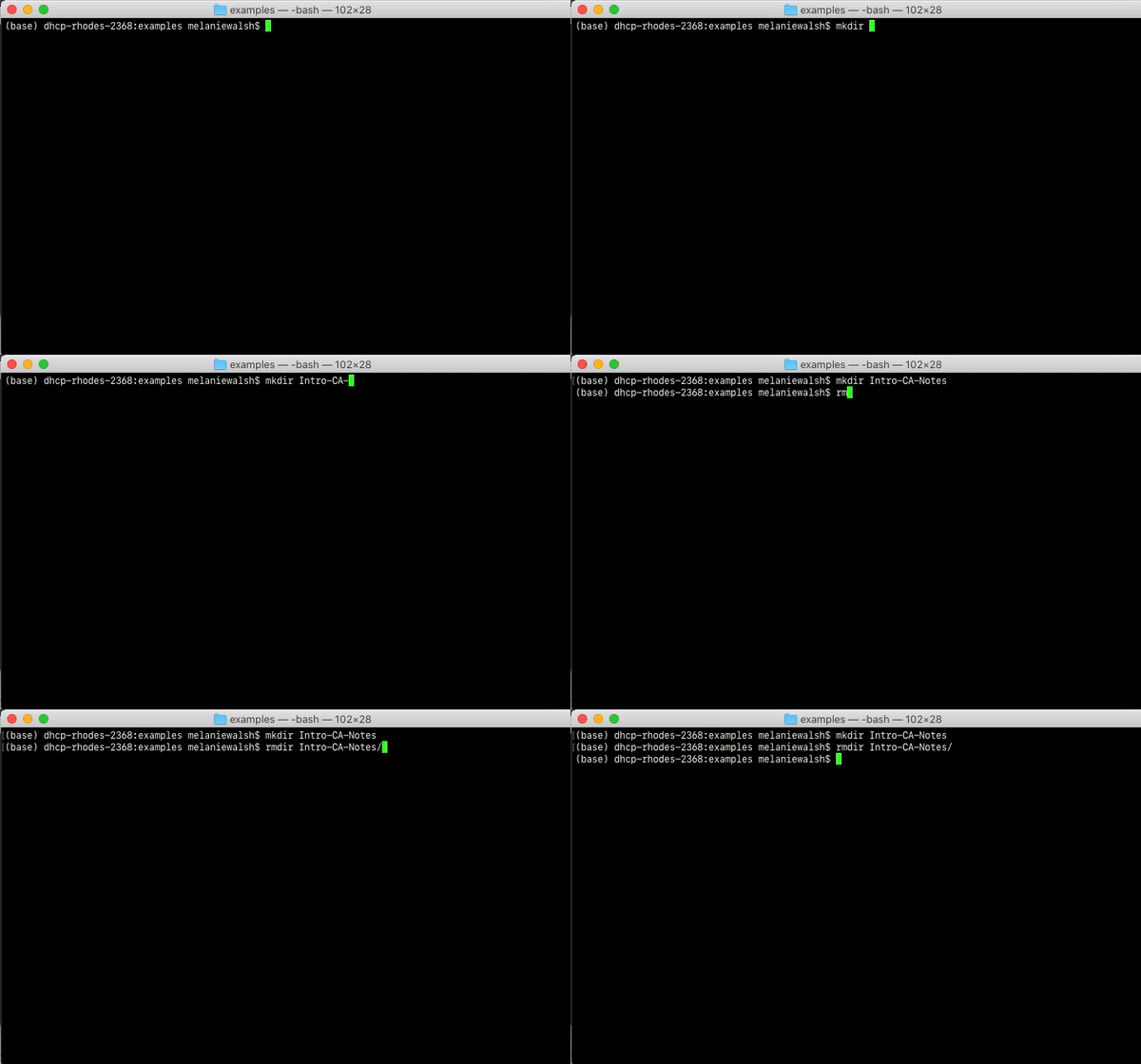
A terminal is a way to interact with your computer via text commands.

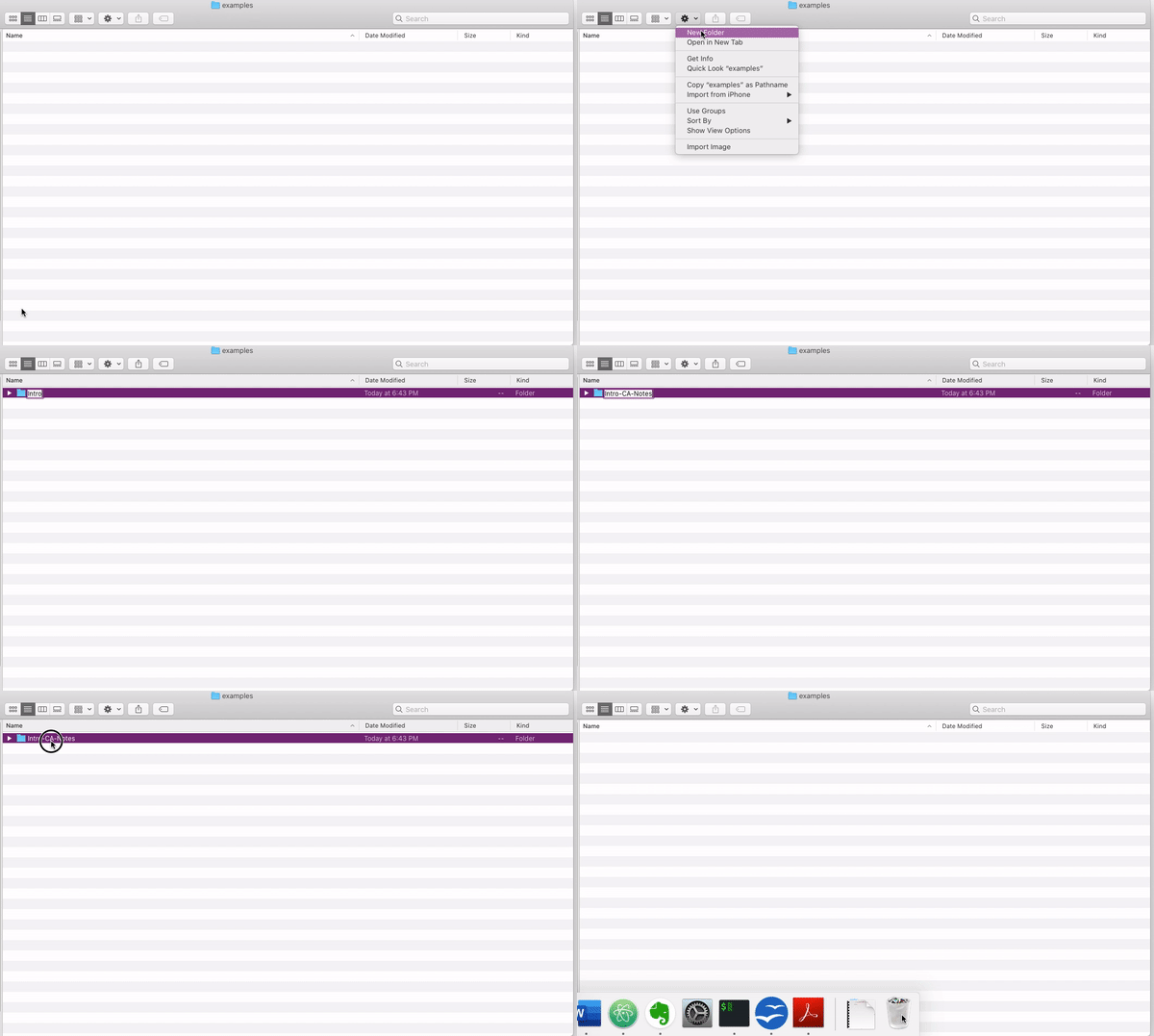
Instead of clicking on icons (GUI), we type explicit commands.

You’ve already used it!

python3 --version

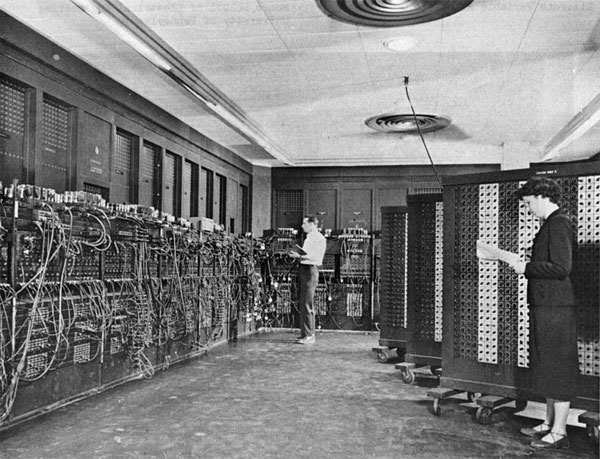
A Brief History of Computing

Early computer (ENIAC)

Punch Cards

Example punch card from the Index Thomisticus

Punch Cards

  • One of the first Computing in the Humanities projects started in the 1940s to digitize the writings of Thomas Aquinas. More information available here https://theoreti.ca/?p=6096
  • For more on this history, I would highly recommend watching “Computer History: Punch Cards Historical Overview -IBM Remington Rand UNIVAC - History 1900’s-1960’s”, 2016. https://www.youtube.com/watch?v=kKJxzay85Vk.

The First GUI

SmallTalk: The First GUI

Reimer, Jeremy. “A History of the GUI.” Ars Technica, May 5, 2005. https://arstechnica.com/features/2005/05/gui/.

Shells?
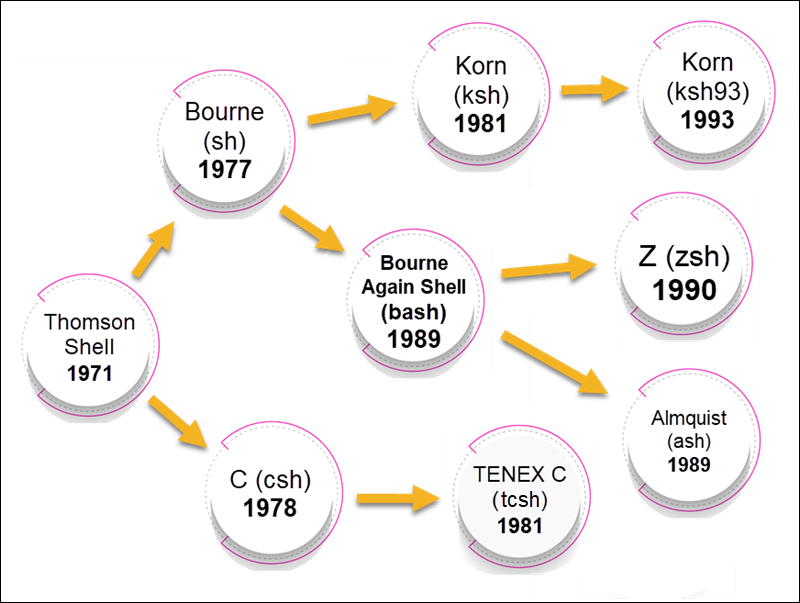
Key Terminology

Term Definition
Terminal The device/program that allows you to interact with the computer
Shell A program that interprets your commands (bash, zsh, PowerShell)
Command Line The text-based interface where you type commands

GUI vs CLI

GUI (Graphical) GUI example

CLI (Command Line) CLI example

Working With The Command Line

Creating a Directory

Open your terminal in VS Code: Terminal > New Terminal

mkdir Intro-CA-Notes

But how do we know it worked?

Writing Vs. Prompting

We have two options: - look at the Command Line cheatsheet that contains a number of these commands and see what would be the best option to help us check if this worked.

Writing Vs. Prompting

Our other option is to try and start testing out these AI Chatbots, and specifically GitHub Co-Pilot (though again you are welcome to use any AI tool that is free and helps you understand these materials).

Prompt Engineering

What is a Prompt?

In the terminal: the symbol that indicates where you type

  • $ (bash)
  • % (zsh)
  • > (PowerShell)

In AI: the text input you give to a chatbot

The AI Explosion

Evolution of LLMs

Terminal vs AI Prompting

Terminal Commands AI Prompts
Fixed, specific syntax Natural language
Predictable outputs Variable outputs
Must use exact commands Flexible phrasing
Reproducible Rarely reproducible

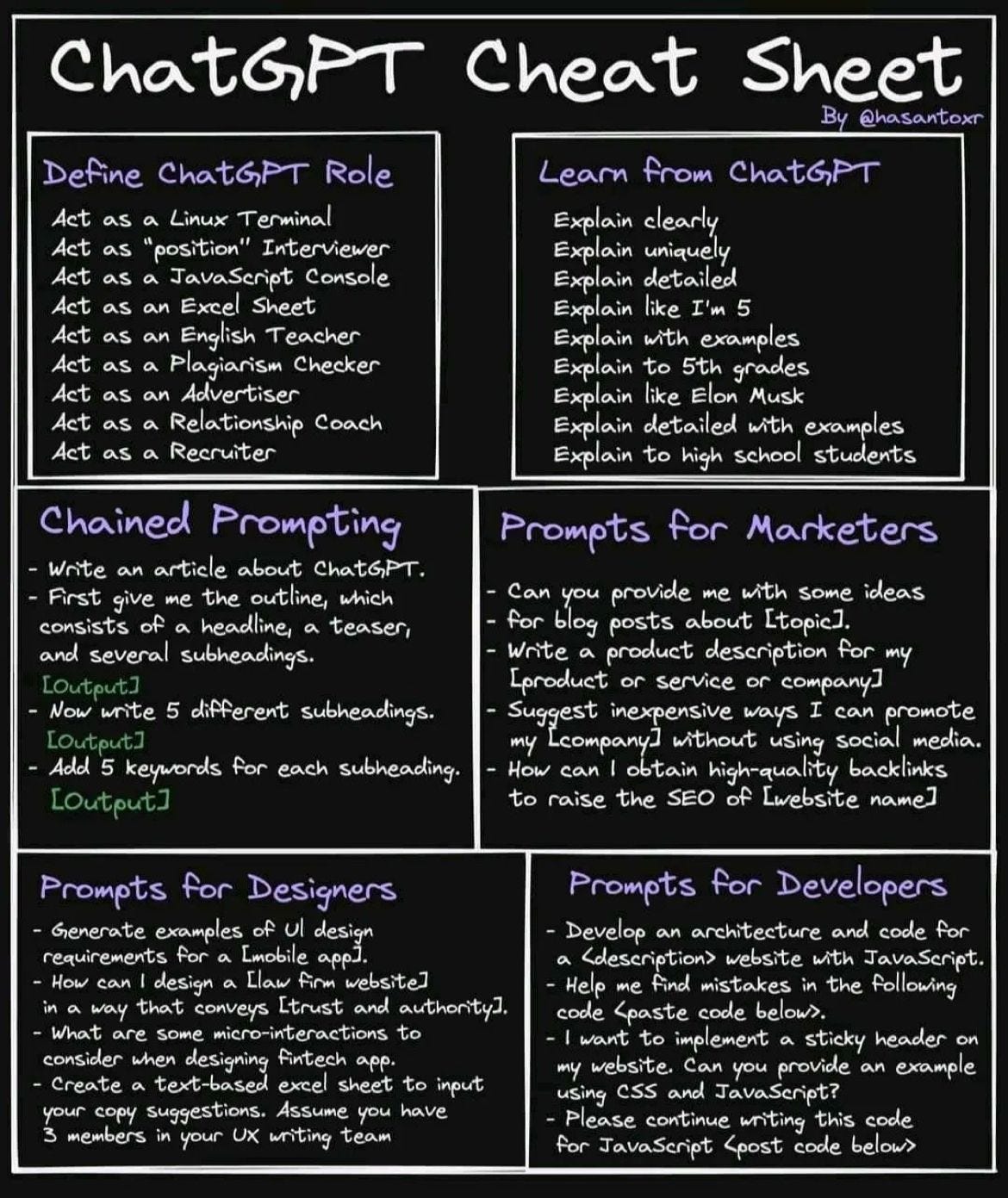
Prompting Guidelines?

Infographics Abound

The 4S of Prompt Engineering

Microsoft’s guidelines for GitHub Copilot:

  • Single - One task or question at a time
  • Specific - Detailed requests and specifications
  • Short - Be concise
  • Surround - Keep relevant files open for context

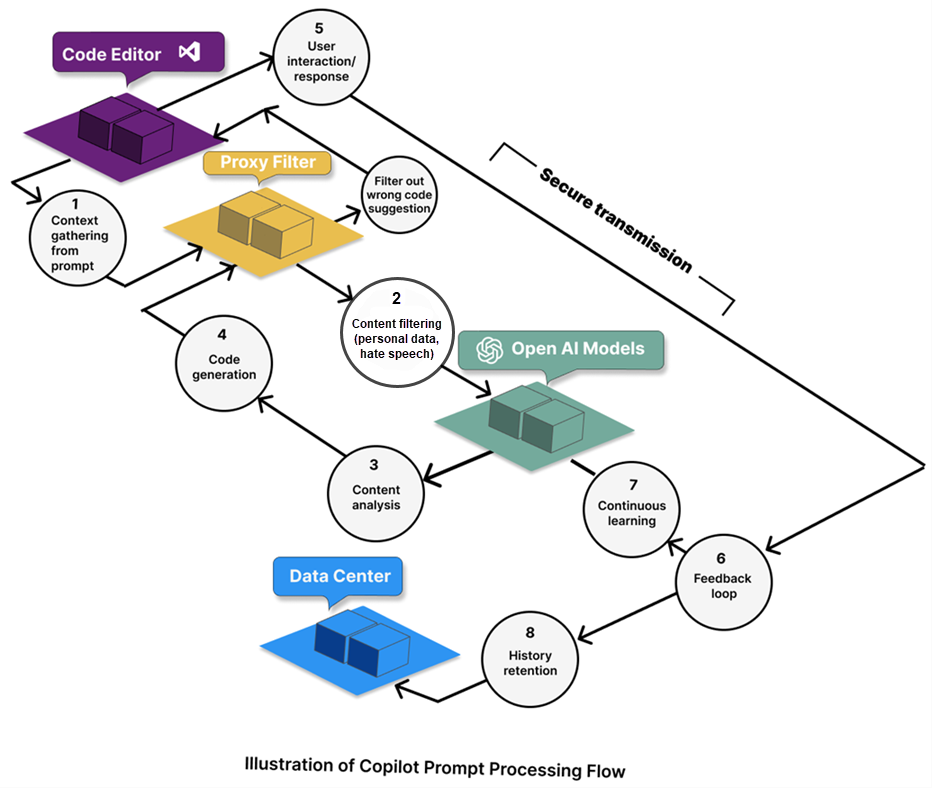
How Copilot Processes Prompts

Copilot processing flow

Important Warning

Never share sensitive information in prompts!

  • Personal data can be leaked
  • Copilot scrapes GitHub repositories
  • The legality and ethics remain hazy

Use AI tools with a critical lens

Example Prompts for the CLI

Try these prompts!

How can I check if my directory was created in my terminal?
Should I use the command ls or pwd to check if my directory
was created? And what is the difference between these two?
How can I create a directory named is310-culture-as-data
in my terminal?

Directories & File Paths

So returning to our original question, hopefully by now we have discovered some of the commands we can use to check if our directory was created. Any thoughts?

Essential Commands

Command What it does
pwd Print working directory (where am I?)
ls List directory contents
cd Change directory
mkdir Make a new directory
touch Create a new file
mv Move or rename files
rmdir Remove an empty directory

Making Directories?

mkdir is310-culture-as-data

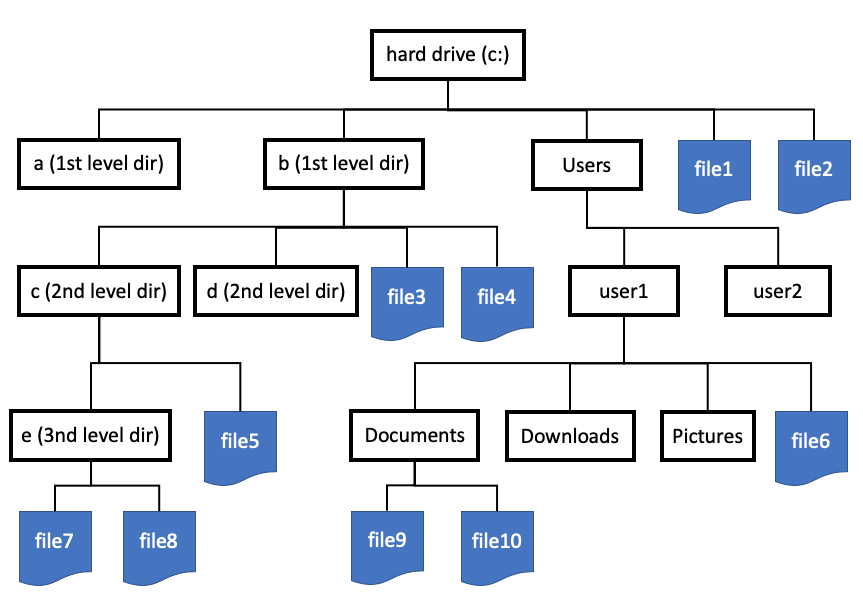
Understanding File Paths

File tree structure

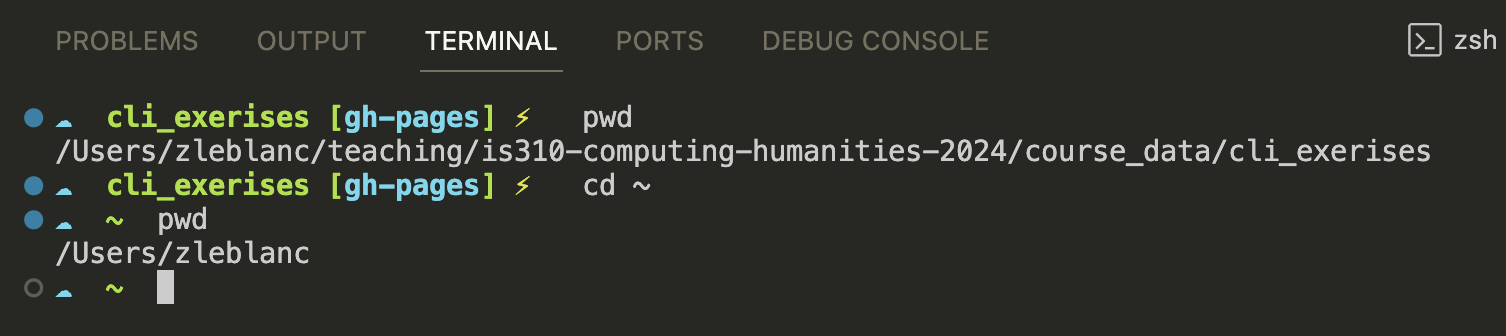
Working Directories

Current Directory

Absolute vs Relative Paths

Absolute path: Full path from root

/Users/zleblanc/Documents/is310

Relative path: Path from current location

cd ~        # Go to home directory
cd ..       # Go up one directory
cd ../..    # Go up two directories

Putting It Together

# Create a file
touch is310-culture-as-data.txt

# Move it into a folder
mv is310-culture-as-data.txt is310-culture-as-data

# Change into the folder
cd is310-culture-as-data

# List contents to verify
ls

# Go back up and remove the folder
cd ..
rmdir is310-culture-as-data

In-Class Exercise

Your Tasks

Using the cheatsheet and/or your preferred AI chatbot:

  1. Create is310-culture-as-data directory in your Desktop folder
  2. Inside it, create is310-culture-as-data.txt
  3. Add text to your file using the command line (new command!)
  4. Display the file contents (new command!)
  5. Return to your home directory

Bonus: Copy your folder, then delete the copy

Additional Resources

  1. Introduction to the Bash Command Line - Programming Historian
  2. Bash Basics Part 1 - Video tutorial
  3. Beginner’s Guide to the Bash Terminal
  4. CodeAcademy Command Line Course

Questions?

Remember:

  • The terminal is the interface
  • The shell interprets commands
  • The command line is where you type
  • Prompts work for both CLI and AI!

What is Version Control?

The Problem

Have you ever had files like this?

  • essay_final.docx
  • essay_final_v2.docx
  • essay_FINAL_FINAL.docx
  • essay_FINAL_FINAL_actually_final.docx

Version control solves this problem!

What is Git?

Git is software for version control - tracking changes in files over time.

  • Created in 2005 by Linus Torvalds (creator of Linux)
  • Most popular version control system in the world
  • Used by millions of developers and researchers

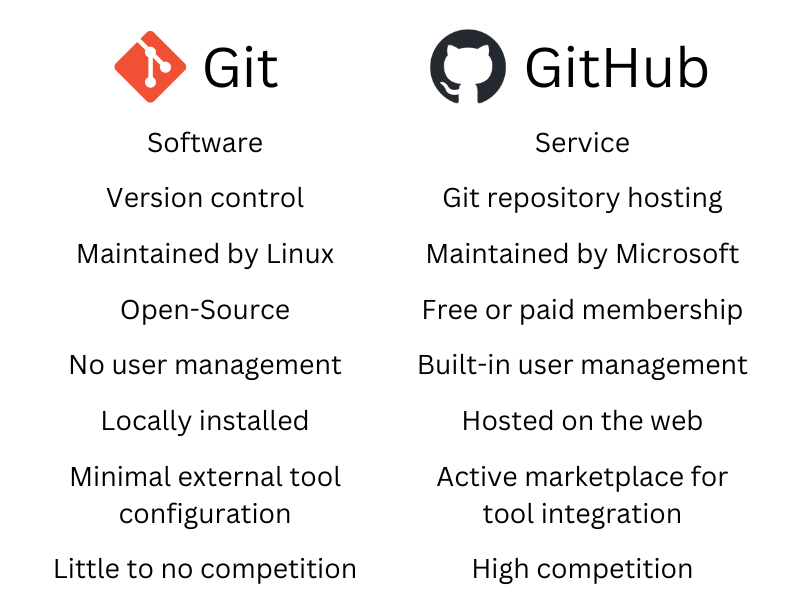
Git vs GitHub

Git GitHub
What Version control system Platform for hosting git repositories
Where Local (on your computer) Remote (website)
Install? Yes No (it’s a website)

They are two separate technologies often used together!

Git + GitHub Together

Git and GitHub workflow

Why Git for Culture as Data?

Git allows you to:

  • Keep track of changes in plain text files
  • Collaborate in real-time with other researchers
  • Easily revert to earlier versions
  • Create different branches to explore new ideas
  • See who added what to the project

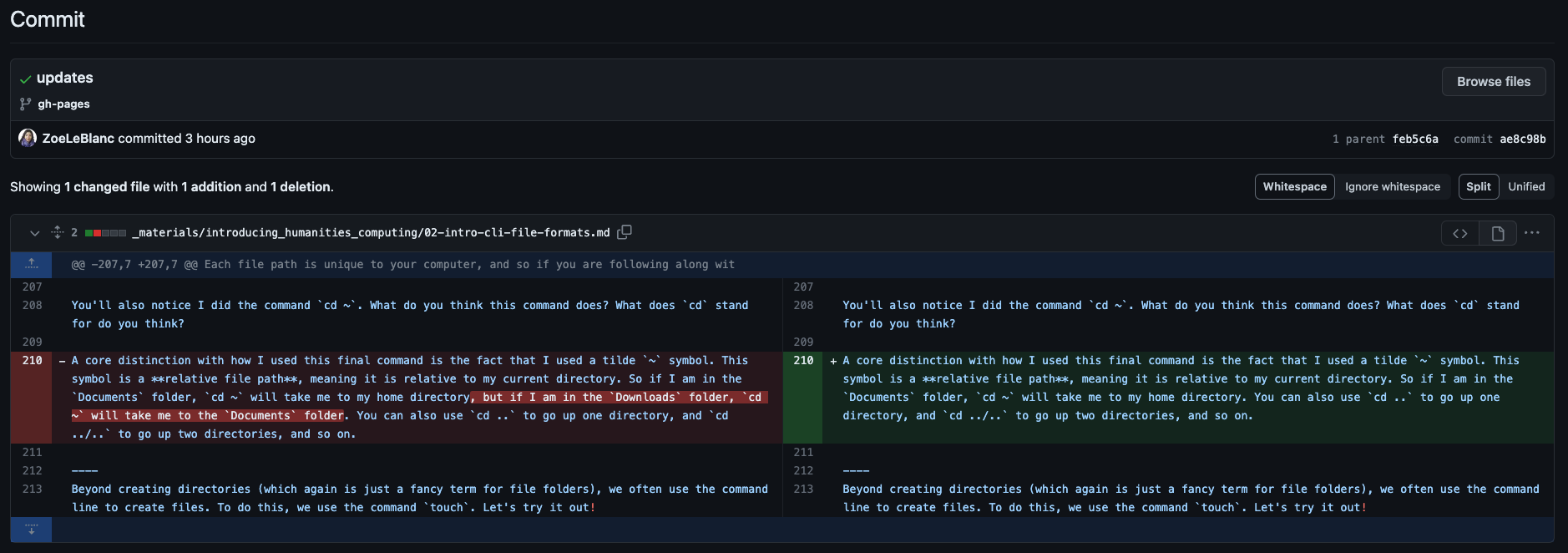
What Version Tracking Looks Like

Example of a git diff

Working with Git

Check Your Installation

First, verify git is installed:

git --version

You should see something like:

git version 2.39.0

Create a Project Folder

# Create a new folder
mkdir is310-first-repo

# Navigate into it
cd is310-first-repo

# Create a file
touch first_file.txt # For Unix/Linux
New-Item -ItemType File -Path . -Name first_file.txt # For PowerShell

Add some text to the file:

echo "This is my first file" > first_file.txt # For Unix/Linux

"This is my first file" | Out-File -FilePath first_file.txt #For PowerShell

Initialize a Git Repository

git init

Output:

Initialized empty Git repository in /Users/YOU/is310-first-repo/.git/

A hidden .git folder is created. We can use ls -a for Unix/Linux or Get-ChildItem -Force for PowerShell to see it.

The Git Workflow

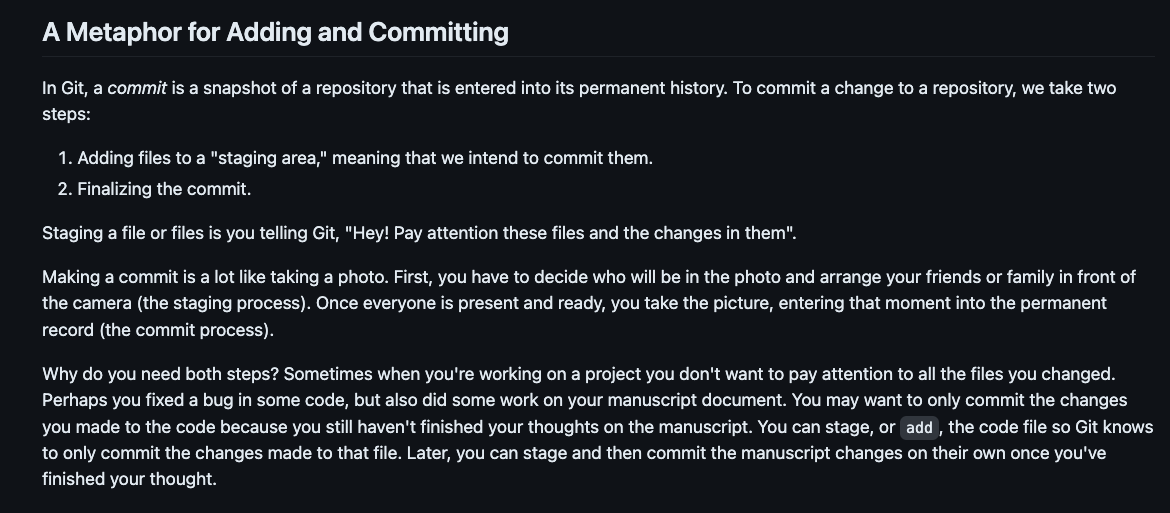
Git as a camera

Think of git as a camera taking snapshots of your project

Step 1: Add to Staging Area

Git doesn’t track automatically - you must tell it what to track:

git add first_file.txt

Check the status:

git status
On branch main

No commits yet

Changes to be committed:
    new file:   first_file.txt

Step 2: Commit Changes

Finalize your snapshot with a descriptive message:

git commit -m "Added first file to our repository"

Check status again:

git status
On branch main
nothing to commit, working tree clean

If You Forget the -m Flag…

You’ll see Vim (a text editor):
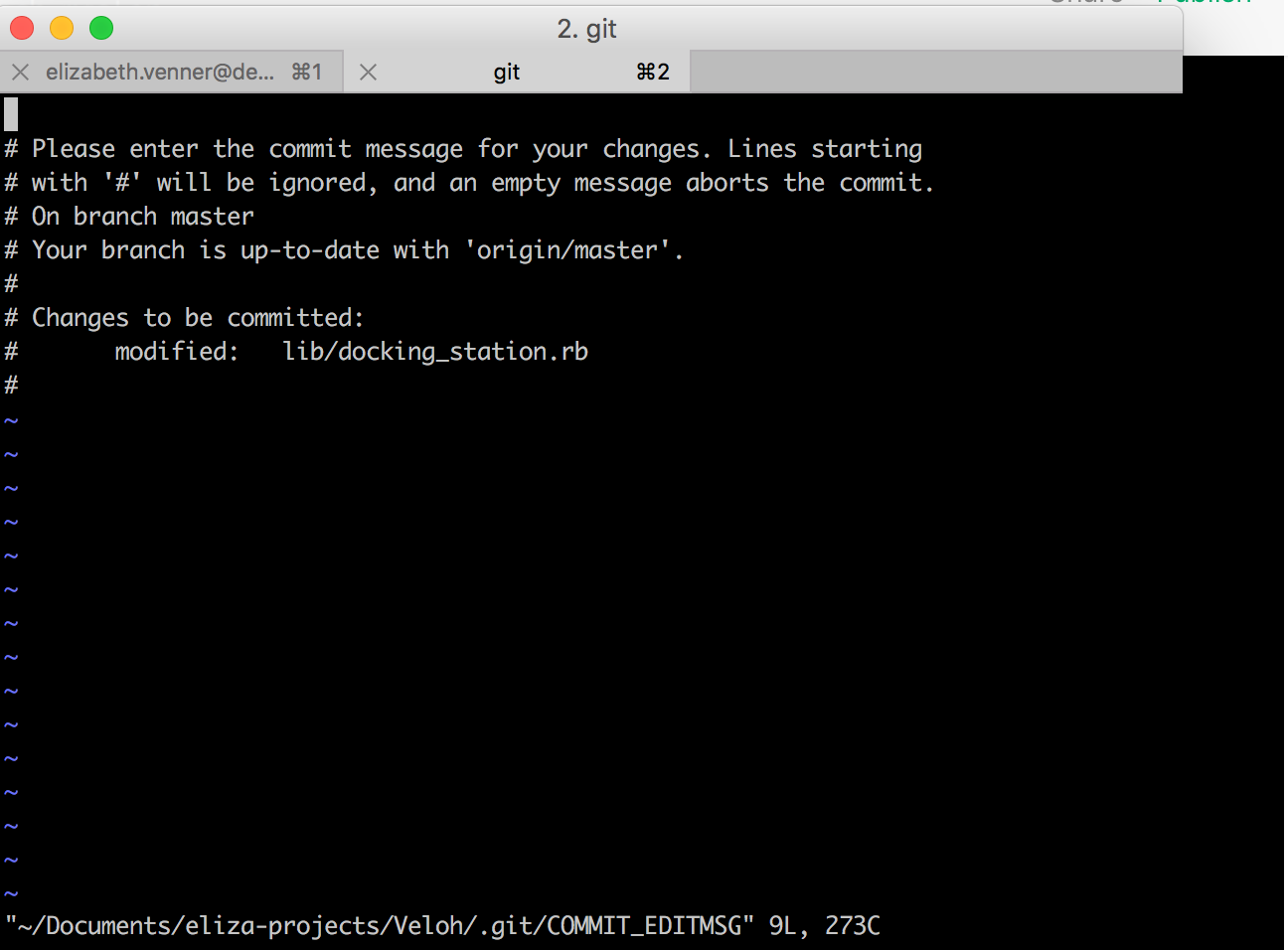
Vim editor

If You Forget the -m Flag…

  • Press i to type, then esc, then :wq to save and exit
  • Or press esc, then :q! to exit without saving
Aborting commit due to empty commit message.

Quotes

quote>

Step 3: View History

See your commit history:

git log
commit 8bb8306c1392eed52d4407eb16867a49b49a46ac (HEAD -> main)
Author: Your Name <your-email@gmail.com>
Date:   Tue Jan 22 16:03:39 2024 -0400

    Added first file to our repository

Git Commands Summary

Command What it does
git init Initialize a repository
git add <file> Add file to staging area
git commit -m "msg" Commit with message
git status Check current status
git log View commit history

Working with GitHub

By now you should have your git configuration setup and have a GitHub account, but feel free to look back at our course tools lesson if you’re having any issues.

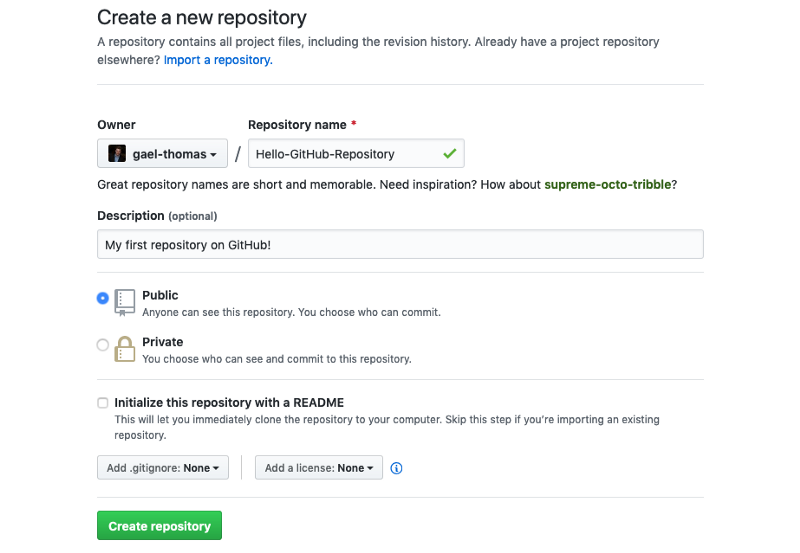
Creating a Repository on GitHub

  1. Go to github.com
  2. Click the New button

Create repo button

Repository Settings

Repository Settings
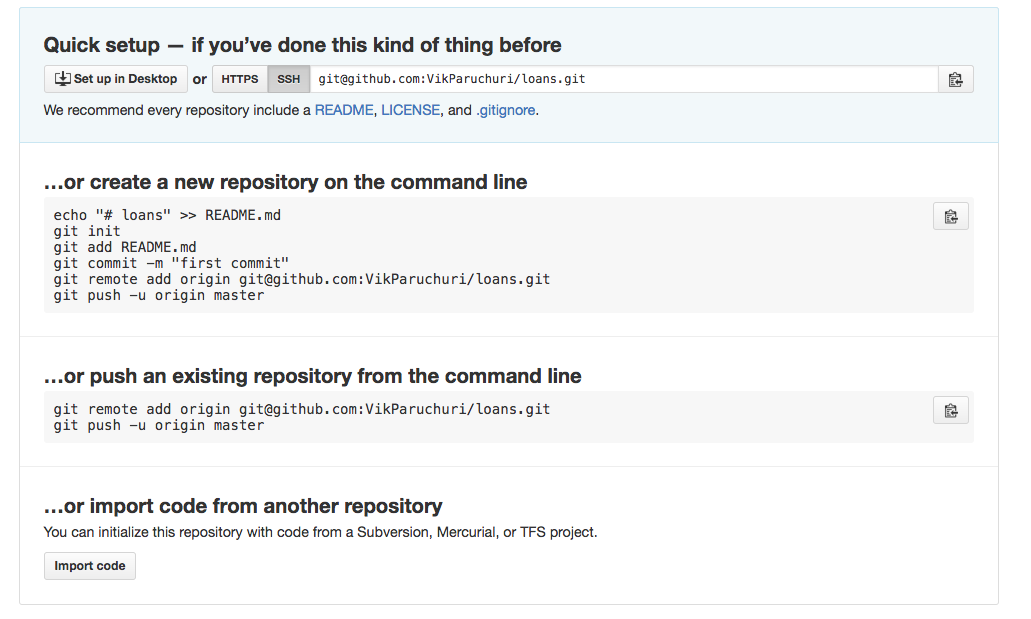
  • Name it is310-first-repo
  • Choose Public so we can see each other’s work
  • Leave README unchecked for now

Repository Settings

First Commit

Repository Settings
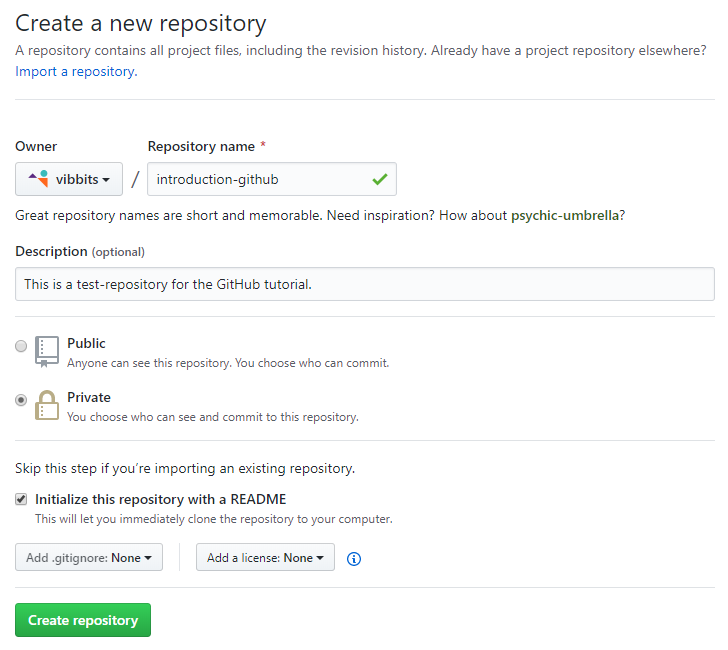
First Commit With README

To understand what each button does feel free to browse through our advanced git and GitHub resource, but first let’s try to get our local repository onto GitHub.

Connect Local to Remote

Add your GitHub repo as a “remote”:

git remote add origin https://github.com/USERNAME/is310-first-repo.git

Connect Local to Remote

Verify it worked:

git remote -v
origin  https://github.com/username/repository.git (fetch)
origin  https://github.com/username/repository.git (push)

Push to GitHub

git push [remote repository] [flags] [local repository]

Push to GitHub

Send your local commits to GitHub:

git push origin main
Enumerating objects: 3, done.
Counting objects: 100% (3/3), done.
Writing objects: 100% (3/3), 226 bytes | 226.00 KiB/s, done.
To github.com:username/is310-first-repo.git
 * [new branch]      main -> main

Fatal Errors?

If you see a fatal error that looks like this:

fatal: 'origin' does not appear to be a git repository
fatal: Could not read from remote repository.

Please make sure you have the correct access rights
and the repository exists.

Editing on GitHub

Create Files in the Browser

Click Add file > Create new file

Add file button

Create a README.md

Create a README.md
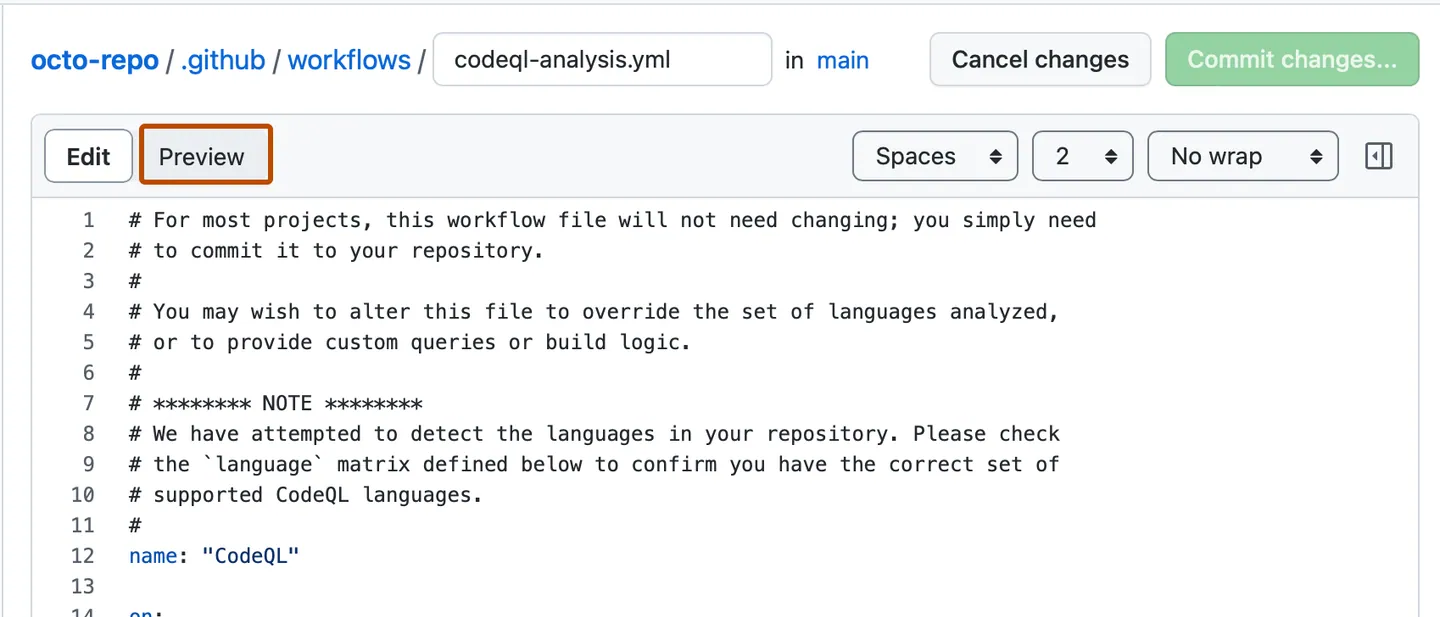
Name your file README.md and add:

# IS 310 Test Repository

This is my first repository.

Create a README.md

  • Click Preview to see formatted output
  • Click Commit changes
  • Add a commit message
  • Select main branch

GitHub Dev (Bonus Feature)

Change github.com to github.dev in your URL. So for us, we would change https://github.com/[USER NAME]/is310-first-repo to https://github.dev/[USER NAME]/is310-first-repo.
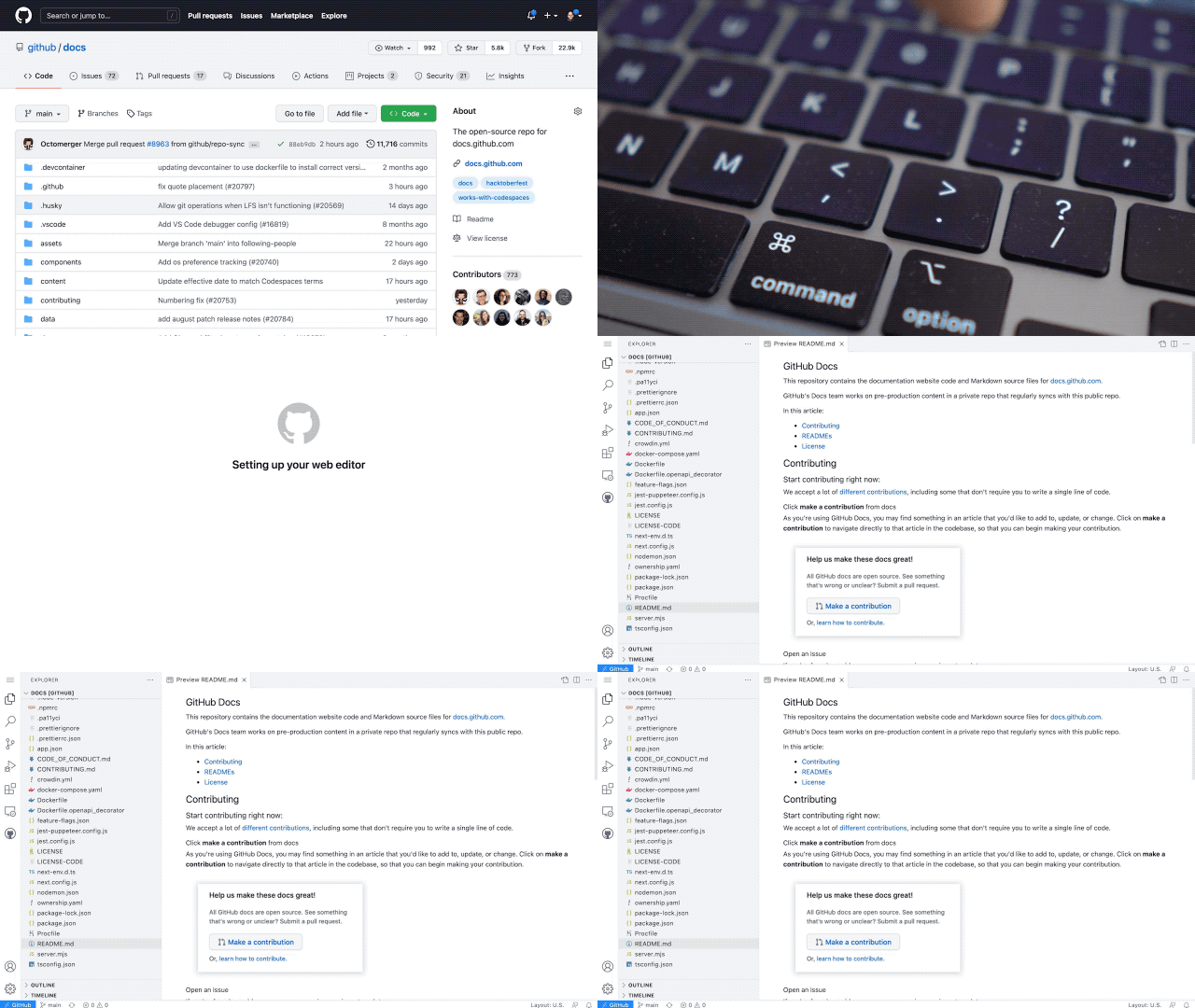
GitHub Dev

GitHub Dev (Bonus Feature)

Or press . on any repository
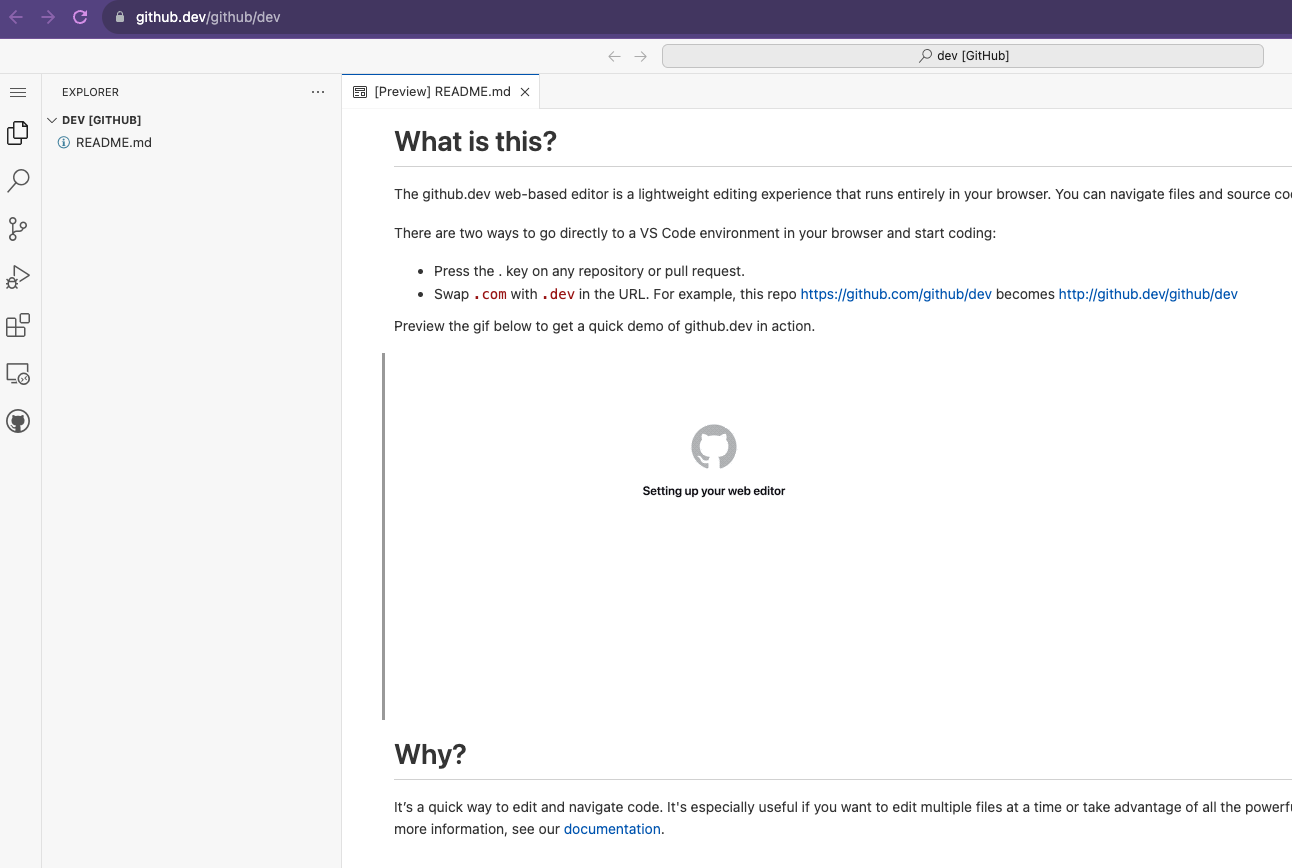
GitHub Dev interface

It’s VS Code in your browser! You can read more about it https://docs.github.com/en/codespaces/the-githubdev-web-based-editor.

Pulling Changes

The Problem

Now we have two versions:

  • Local repository (on your computer)
  • Remote repository (on GitHub)

They have different files! How do we sync them?

Pull from GitHub

git pull origin main
remote: Enumerating objects: 4, done.
remote: Counting objects: 100% (4/4), done.
remote: Compressing objects: 100% (2/2), done.
remote: Total 3 (delta 0), reused 0 (delta 0), pack-reused 0
Unpacking objects: 100% (3/3), 935 bytes | 233.00 KiB/s, done.
From github.com:ZoeLeBlanc/is310-first-repo
 * branch            main       -> FETCH_HEAD
   d8dad7b..832b673  main       -> origin/main
Updating d8dad7b..832b673
Fast-forward
 README.md | 1 +
 1 file changed, 1 insertion(+)
 create mode 100644 README.md

Now ls shows the README.md file locally!

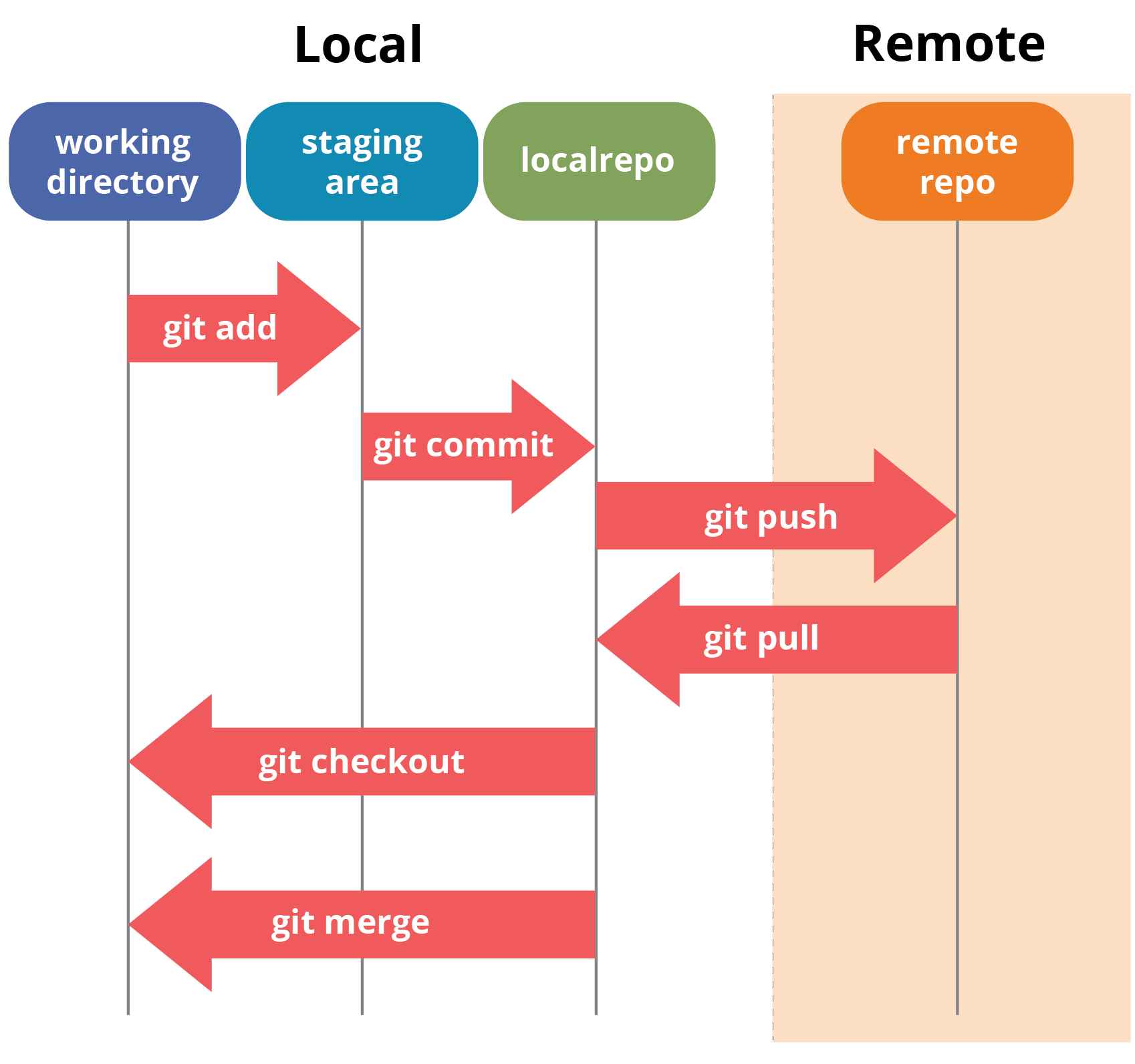
The Complete Workflow

Git architecture

Core Workflow Summary

  1. Edit files locally
  2. Add to staging: git add <file>
  3. Commit snapshot: git commit -m "message"
  4. Push to GitHub: git push origin main
  5. Pull from GitHub: git pull origin main

Homework: Init IS310

Your Assignment

  • Create a new GitHub repository called is310-coding-assignments.
  • Create a new directory in your local computer called is310-coding-assignments and enable it as a git repository.
  • Create a Markdown file called README.md within is310-coding-assignments.
  • Create a folder called images within is310-coding-assignments.

README Template

# Init IS310 Homework

## Proof of Installation

1. Python

![Python Installation](images/python-installation.png)

2. Git

![Git Installation](images/git-installation.png)

3. VS Code

![VS Code Installation](images/vscode-installation.png)

Pushing Your Homework

git add .
git commit -m "Init IS310 Homework"
git push origin main

Remember to connect local to remote first:

git remote add origin https://github.com/USERNAME/is310-coding-assignments.git

Post your repo link in the discussion forum!

Resources

Questions?

Key takeaways:

  • Git = local version control
  • GitHub = remote hosting platform
  • Workflow: edit → add → commit → push/pull
  • Commit messages should be descriptive!