Course Policies
Any statement with an * has been copied from the iSchool Syllabus Template.
Grades
Incomplete grades
An exceptional request for an incomplete grade is most often granted to students encountering a medical emergency or other extraordinary circumstances beyond their control. Students must request an incomplete grade from the instructor. The instructor and student will agree on a due date for completion of coursework. The student must submit an Incomplete Form signed by the student, the instructor, and the student’s academic advisor to the front office: https://uofi.app.box.com/s/sx7arobhr0gfw12teaetmp1qq32ifdrd Please see the Student Code for full details: http://studentcode.illinois.edu/article3/part1/3-104/
Grading Scale
Include the grading scale used in the course. If you permit A+ grades, or have other measures for grading please include them here. Suggested grading scale:
| Percentage Range | Grade |
|---|---|
| 94-100 | A |
| 90-93 | A- |
| 87-89 | B+ |
| 83-86 | B |
| 80-82 | B- |
| 77-79 | C+ |
| 73-76 | C |
| 70-72 | C- |
| 67-69 | D+ |
| 63-66 | D |
| 60-62 | D- |
| 59 and below | F |
Attendance*
The iSchool expects students to attend all classes except in cases of emergency. Student Code on Attendance: http://studentcode.illinois.edu/article1/part5/1-501/
I believe that in-person attendance is important for your learning and for building a collaborative classroom community. However, I also recognize that life happens—illness, family emergencies, mental health needs, and other circumstances sometimes require missing class.
If You Need to Miss Class: If you are feeling unwell or have been exposed to illness, please stay home and prioritize your health. I do not require doctor’s notes for absences. However, please keep in mind that if you miss a substantial portion of class meetings, it will be difficult to make up missed content and that you need to coordinate with your group members who depend on your contributions.
When you miss class:
- Message me on Slack as soon as possible to let me know
- Inform your group members so they can plan accordingly
- Check in with me about making up missed content and assignments
- Review materials posted on the course website
I am happy to help you catch up on content within reason, though I cannot reteach multiple weeks of material. If you are facing challenges that require extended absences, please reach out so we can discuss accommodations.
Information Overload Days:
At the same time, at points throughout the semester you might simply need a break. Instead of missing class because you are overwhelmed with your workload, please let me know how you are feeling and please consider taking an information overload day rather than missing class outright. If you let me know in advance that you need more bandwidth for whatever reason, you will be excused from the assigned materials and in-class discussion. Instead you will be expected to actively listen to the discussion and then consult with the instructor about how to make up any relevant assignments at a later date. You will also have to inform your group of your status and help them decide how to make up for missed work. But hopefully showing each other grace and kindness can further foster your collaboration.
I realize the workload for this course is significant and that you are balancing a number of other commitments at the same time, so information overload days are intended to help you manage your stress and at the same time help you not fall behind in the course. You are welcome to two of these without any questions, but after that point it would be helpful to have a conversation about your situation so that you don’t fall behind.1
Worst case scenarios:
If you or someone close to you becomes ill and you are no longer able to attend class or complete the final project, I will in consultation with you determine a final grade based on your existing work, and/or advocate for you to be able to move the course to pass/fail.
For groups that lose a member(s) in such a scenario, the Instructor will work with you to pivot and determine how to best complete your final project. Members of the group will not be penalized for the missing member, but instead evaluated on their ability to manage the situation.
Depending on the urgency of your situation, I realize that communicating with your instructor is a low priority, but please get in touch when you can to let me know if anything comes up.
Communication and Respect
We will be meeting in person, barring any emergencies, but we will also be using Slack, an asynchronous communication platform, to encourage communication beyond our in-person meetings. Our Slack server is the DH@UIUC Slack (DH stands for digital humanities) and you can access the link in Canvas. Once you have joined our Slack, you should join our #is310-spring-2026 channel (or ask one of the instructors for assistance joining). We will discuss more about Slack procedures in class, and you can find more information about the platform on our course website here
You are also welcome to set up meetings with the instructor using this Calendly link or to email the instructor at zleblanc@illinois.edu.
Much of this course is experimental, and students often have a variety of backgrounds and previous relevant experience. This diversity is what makes our course so unique and enriching. Consequently, respect is a core component of our classroom culture, both in in-person interactions and on virtual platforms like Slack. Embracing a respectful attitude in all forms of communication is crucial, as it ensures a productive and positive learning environment. Whether in class discussions, Slack messages, or emails, being considerate and understanding of different perspectives and experiences is key. Remember, every opinion, question, and idea deserves a respectful response and consideration.
Rule of thumb from here on out is when in doubt, ask questions and over-communicate, but do so respectfully!
Disruptive behavior*
Behavior that persistently or grossly interferes with classroom activities is considered disruptive behavior and may be subject to disciplinary action. Such behavior inhibits other students’ ability to learn and an instructor’s ability to teach. A student responsible for disruptive behavior may be required to leave class pending discussion and resolution of the problem and may be reported to the Office for Student Conflict Resolution (https://conflictresolution.illinois.edu; conflictresolution@illinois.edu; 333-3680) for disciplinary action.
Statement of Inclusion*
https://diversity.illinois.edu/about/senate-diversity-resolution/ As the state’s premier public university, the University of Illinois at Urbana-Champaign’s core mission is to serve the interests of the diverse people of the state of Illinois and beyond. The institution thus values inclusion and a pluralistic learning and research environment, one which we respect the varied perspectives and lived experiences of a diverse community and global workforce. We support diversity of worldviews, histories, and cultural knowledge across a range of social groups including race, ethnicity, gender identity, sexual orientation, abilities, economic class, religion, and their intersections.
Religious Observances*
In keeping with our Statement of Inclusion and Illinois law, the University is required to reasonably accommodate its students’ religious beliefs, observances, and practices in regard to admissions, class attendance, and the scheduling of examinations and work requirements.
Religious Observance Accommodation Request form: https://cm.maxient.com/reportingform.php?UnivofIllinois&layout_id=19 Other accommodations may be available.
Accessibility Statement*
To ensure disability-related concerns are properly addressed from the beginning of the semester, I request that students with disabilities who require assistance to participate in this class contact me as soon as possible to discuss your needs and any concerns you may have. The University of Illinois may be able to provide additional resources to assist you in your studies through the office of Disability Resources and Educational Services (DRES). This office can assist you with disability-related academic adjustments and/or auxiliary aids. Please contact them as soon as possible by visiting the office in person: 1207 S. Oak St., Champaign; visiting the website: http://disability.illinois.edu; calling (217) 333-4603 (V/TTY); or via e-mail disability@illinois.edu. NOTE: I do not require a letter from DRES in order to discuss your requested accommodations.
Community of Care*
As members of the Illinois community, we each have a responsibility to express care and concern for one another. If you come across a classmate whose behavior concerns you, whether in regards to their well-being or yours, we encourage you to refer this behavior to the Student Assistance Center (217-333-0050 or http://odos.illinois.edu/community-of-care/referral/). Based on your report, the staff in the Student Assistance Center reaches out to students to make sure they have the support they need to be healthy and safe.
Further, as a Community of Care, we want to support you in your overall wellness. We know that students sometimes face challenges that can impact academic performance (examples include mental health concerns, food insecurity, homelessness, personal emergencies). Should you find that you are managing such a challenge and that it is interfering with your coursework, you are encouraged to contact the Student Assistance Center (SAC) in the Office of the Dean of Students for support and referrals to campus and/or community resources.
Mental Health Resources*
Significant stress, mood changes, excessive worry, substance/alcohol misuse or interferences in eating or sleep can have an impact on academic performance, social development, and emotional wellbeing. The University of Illinois offers a variety of confidential services including individual and group counseling, crisis intervention, psychiatric services, and specialized screenings which are covered through the Student Health Fee. If you or someone you know experiences any of the above mental health concerns, it is strongly encouraged to contact or visit any of the University’s resources provided below. Getting help is a smart and courageous thing to do for yourself and for those who care about you.
- Counseling Center (217) 333-3704
- McKinley Health Center (217) 333-2700
- National Suicide Prevention Lifeline (800) 273-8255
- Rosecrance Crisis Line (217) 359-4141 (available 24/7, 365 days a year)
If you are in immediate danger, call 911.
Emergency Response Recommendations*
Emergency response recommendations and campus building floor plans can be found at the following website: https://police.illinois.edu/em/run-hide-fight/. I encourage you to review this website within the first 10 days of class.
Additional Resources*
Students experiencing economic hardships resulting in food insecurity, housing insecurity, homelessness, or other issues that may affect the quality of their work, are encouraged to reach out to iSchool Assistant Dean for Student Affairs, April Carter at acart22@illinois.edu or call 217-333-0532.
Sexual Misconduct Reporting Obligation*
The University of Illinois is committed to combating sexual misconduct. Faculty and staff members are required to report any instances of sexual misconduct to the University’s Title IX Office. In turn, an individual with the Title IX Office will provide information about rights and options, including accommodations, support services, the campus disciplinary process, and law enforcement options.
A list of the designated University employees who, as counselors, confidential advisors, and medical professionals, do not have this reporting responsibility and can maintain confidentiality, can be found here: wecare.illinois.edu/resources/students/#confidential. Other information about resources and reporting is available here: wecare.illinois.edu.
Library Resources*
https://www.library.illinois.edu/infosci/
The iSchool Academic Support Center*
The iSchool Academic Support Center offers academic success workshops; coordinates with faculty and instructors to provide support for specific courses or exams; and curates and shares academic support resources. Appointments are available online and in person in room 4020 (Academic Support Center) in the 614 E. Daniel iSchool building. For more information including hours of operation, please visit https://ischool.illinois.edu/student-life/academic-support-center.
Academic and Self Integrity*
The iSchool has the responsibility for maintaining academic integrity so as to protect the quality of education and research in our school and to protect those who depend on our integrity. Consequences of academic integrity infractions may be serious, ranging from a written warning to a failing grade for the course or dismissal from the University. See the student code for academic integrity requirements: http://studentcode.illinois.edu/article1/part4/1-401/
Long story, short: don’t cheat. If you need help, see the instructor. I would rather you turn in work late, than have you plagiarize materials and have to report you for violating the student code.
We’ll discuss what constitutes plagiarism for the course (it gets thorny around coding sometimes), but a good rule of thumb is to cite as much as possible. All scholarship is a collective endeavor, and acknowledging those whose work has influenced you is both intellectually and politically imperative.
Sara Ahmed writes that citation serves as feminist bricks and feminist memory: > “Citation is how we acknowledge our debt to those who came before; those who helped us find our way when the way was obscured because we deviated from the paths we were told to follow. In this book, I cite feminists of color who have contributed to the project of naming and dismantling the institutions of patriarchal whiteness” (Ahmed 17). Acknowledging and establishing feminist genealogies is part of the work of producing more just forms of knowledge and intellectual practice. —Beverly Weber, Digital Feminist Collective2
AI Policy
This course explicitly allows the use of so-called AI tools, and we will be experimenting primarily with GitHub Co-Pilot throughout the semester for our programming related research and learning. Such a choice might seem strange given current discourses around AI, but this course’s approach to AI is premised on the belief that these tools are not going anyways and that we need to engage with them critically.
To that end, students are allowed and encouraged to use AI tools for various assignments and projects, but you are required to explicitly share your preferred workflow in this course. In the first two weeks of class, you will submit your preferred Course Workflow as your first assignment where you will address the following questions:
- If you plan to use AI tools: Describe how you intend to integrate them into your work. Which tools will you use? For what purposes? (Examples: coding assistance, brainstorming, proofreading, data analysis, literature search, etc.)
- If you prefer not to use AI tools: Explain your alternative workflow and how you plan to complete assignments without AI assistance. You will need to document your process differently (see below).
- If you plan to use local models: Indicate this and consult with the instructor for setup assistance. Running models locally gives you more control and privacy.
If Your Workflow Changes
AI use is iterative and experimental. If your approach changes during the semester (e.g., you decide to start using AI after initially opting out, or vice versa), simply update your workflow statement. No judgment—experimentation is encouraged.
Opting Out: Alternative Documentation Requirements
If you choose not to use AI tools, you should contact the Instructor either in Class or via Slack to determine the best approach to document your workflows. This may involve using versioning functionality in git and Google Drive, or other tools. The goal is ensuring I can assess your learning process without AI assistance as evidence.
Using Agentic AI: Higher Expectations
If you choose to use highly agentic AI tools (tools that can autonomously complete complex tasks with minimal guidance), you’ll be held to higher standards for the course, but specifically the final project, including more more sophisticated analysis in your data essay; more rigorous documentation of how you used AI; more extensive engagement with scholarship; and deeper reflection on how automation influenced your final project. Essentially, if AI is doing more of the technical work, you need to demonstrate more sophisticated intellectual work. This is not intended as a penalty or to dissuade you from using these tools—it is recognizing that using powerful tools requires showing you understand their implications and raising expectations so that you can maximize your learning in this course.
What “Agentic AI” Means:
For this course, agentic AI includes:
- Tools that can autonomously write, debug, and execute complex code with minimal guidance
- Tools that can independently conduct multi-step research or analysis tasks
- Tools that can generate substantial portions of written work with minimal human input
If you are unsure whether a tool counts as “agentic,” ask. Better to clarify than assume.
Access & Equity with AI
To ensure equal access, we will primarily utilize AI tools that are free of charge, specifically GitHub Copilot (free for students with GitHub Student Developer Pack) or open-source local models (instructor can provide setup guidance). You will need to disclose if you are using a paid tool, and I would strongly suggest first checking if whatever tool you are using has an education discount.
Students are encouraged to explore using local AI models (models that run on your own computer rather than in the cloud). Benefits include:
- Greater privacy—your data does not leave your machine
- No usage limits or costs
- Opportunity to understand how models actually work
- Experience with a different paradigm of AI use
The instructor can provide setup instructions for local models like Llama, Mistral, or others. If you are interested, let me know either in Class or via Slack.
What This Means for Your Work
For coding assignments: You may use AI to help write, debug, and understand code, but make sure you understand what the code does—you are responsible for explaining it. If code breaks or does not work as expected, you need to fix it. A helpful paradigm shift may be trying to think about understanding code not through building it, but breaking it even.
For written work: You may use AI for brainstorming, outlining, drafting, or editing, but your ideas, arguments, and voice should be yours. If an essay reads like it was primarily AI-generated, you will be dinged points. In particular, if you plan to use AI then I will be grading grammar, syntax, and flow. Regardless though, this course encourages you to be creative, original, and ambitious.
For data work: You may use AI to help with data collection, cleaning, analysis, or documentation, but you need to make the interpretive decisions about what matters. Your assignments and data essays must demonstrate you understand your methodology deeply.
AI Academic Integrity
Using AI is not cheating in this course—it is expected. However, plagiarism is still plagiarism. Do not submit work generated by others (human or AI) as if it is entirely your own intellectual contribution. You are expected to be honest and responsible for your submissions. If AI generates incorrect information or problematic code, you are responsible for catching and fixing it.
The Bottom Line: AI should make you more capable, not less thoughtful. It should amplify your learning, not replace it. If you find yourself mindlessly accepting AI suggestions without understanding them, or if you cannot explain what your code does or why your essay makes certain arguments, stop and reassess. That is a sign AI is replacing your learning rather than supporting it, and our goal is to experiment with how AI can augment our work. If you are unsure of how best to work, please reach out to the Instructor and we can discuss options.
Why This Policy? Questions?
Ultimately, AI is increasingly permeating every aspect of academia, as well as our day-to-day lives. Rather than shy away from this fact, we will explore how to integrate AI into our work in sustainable and responsible ways, reflecting on the impact of these technologies and using them to further your learning experience.
If you have concerns about this policy, questions about what is allowed, or uncertainty about whether your approach is appropriate, please ask. Office hours, email, and Slack are all good venues. There are no wrong questions about AI—we are all figuring this out together. This course is about becoming thoughtful, critical users of tools like AI that are reshaping our world. And that requires engaging with them directly, not avoiding them.
Land acknowledgement Statement*
Adopted by the University of Illinois in 2018
More information: https://chancellor.illinois.edu/land_acknowledgement.html
I/We would like to begin today by recognizing and acknowledging that we are on the lands of the Peoria, Kaskaskia, Piankashaw, Wea, Miami, Mascoutin, Odawa, Sauk, Mesquaki, Kickapoo, Potawatomi, Ojibwe, and Chickasaw Nations. These lands were the traditional territory of these Native Nations prior to their forced removal; these lands continue to carry the stories of these Nations and their struggles for survival and identity.3
As a land-grant institution, the University of Illinois has a particular responsibility to acknowledge the peoples of these lands, as well as the histories of dispossession that have allowed for the growth of this institution for the past 150 years. We are also obligated to reflect on and actively address these histories and the role that this university has played in shaping them. This acknowledgement and the centering of Native peoples is a start as we move forward for the next 150 years.
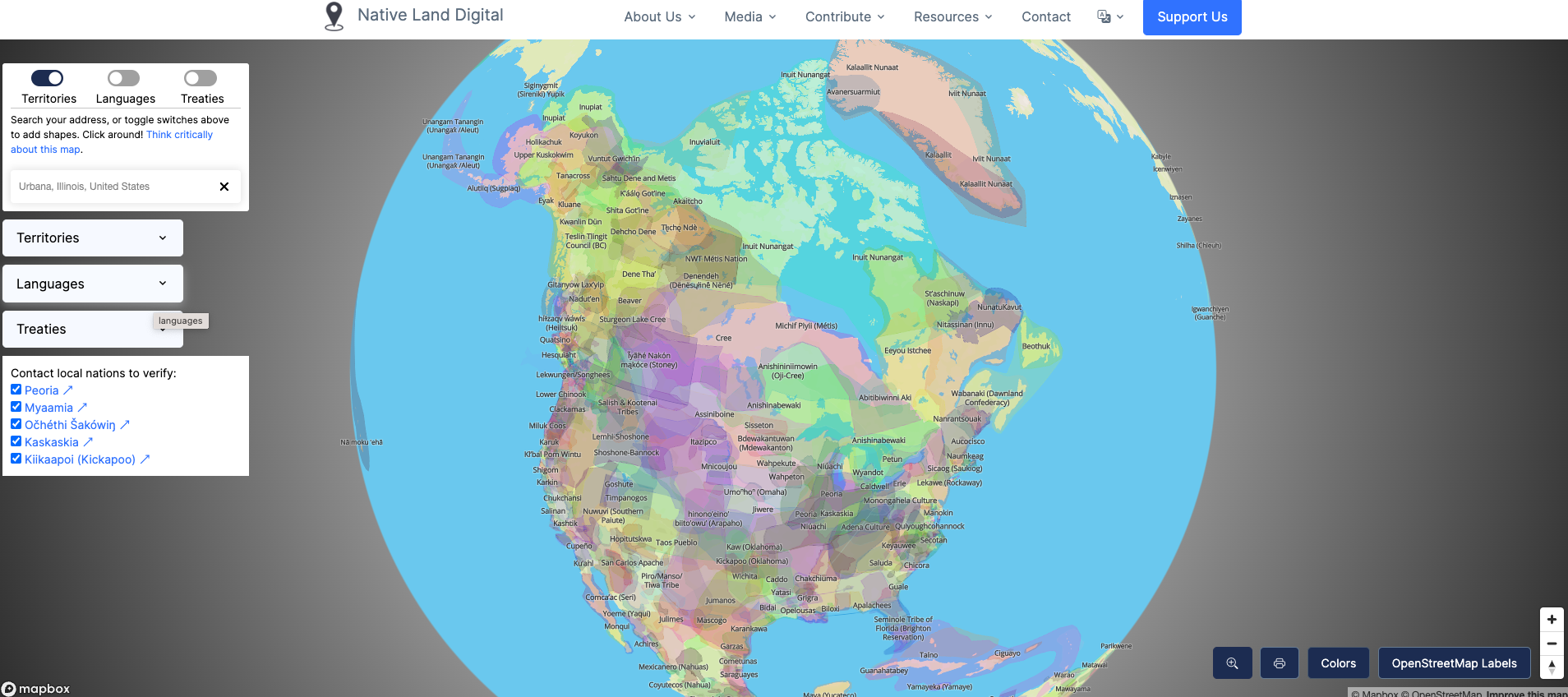
While this acknowledgement is important, I find that these words can be difficult to understand or visualize. To help us understand this history, there are two phenomenal digital humanities projects. The first is Native Land Digital that actually visualizes the lands of these Native Nations, as well as all indigenous lands worldwide. Available at https://native-land.ca/ and built by a Canadian non-for-profit, I would highly encourage you to spend some time looking through the project to understand and see how this dispossession has shaped our very understanding of geography and political identity.
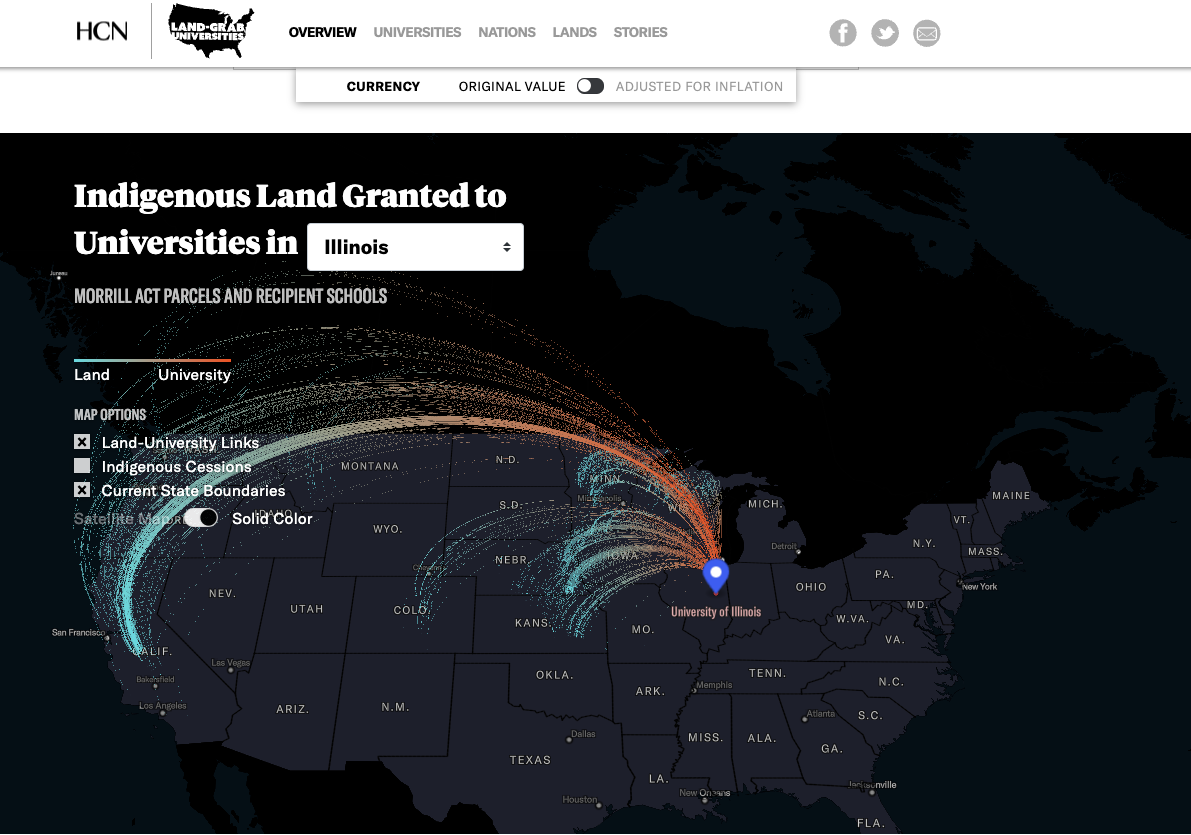
The second project is Land Grab Universities which looks specifically at how the Morill Act, signed in 1862, dispossessed tribal lands to fund the creation of public state universities. The project was built by Robert Lee, Tristane Ahtone, Margaret Pearce, Kalen Goodluck, Geoff McGhee, and Cody Leff and published by High Country News https://www.landgrabu.org/.
Footnotes
The concept of an information overload day is inspired and adapted from Ryan Cordell’s Building A Better Book Syllabus https://f19bbb.ryancordell.org/policies/↩︎
Beverly Weber, “The Politics of Citation” Digital Feminist Collective https://digitalfeministcollective.net/index.php/2018/01/13/the-politics-of-citation/ and Ahmed, Sara. Living a Feminist Life. Duke University Press Books, 2017.↩︎
For those unfamiliar with these tribes, here is the correct phonetic pronunciations: Peoria (pee-OHR-ee-uh), Kaskaskia (kas-KAS-kee-uh), Piankashaw (pee-AN-kuh-shaw), Wea (WEE-uh), Miami (my-AM-ee), Mascoutin (mas-KOO-tin), Odawa (oh-DAH-wuh), Sauk (sawk), Mesquaki (mes-KWAH-kee), Kickapoo (KIK-uh-poo), Potawatomi (pot-uh-WAH-tuh-mee), Ojibwe (oh-JIB-way), Chickasaw (CHIK-uh-saw).↩︎