Introductions & Installations
✨ Welcome to IS310 - Culture As Data Spring 2026 ✨
Who are your instructors?
Lead Instructor: Dr. Zoe LeBlanc (You can call me Prof. LeBlanc or Prof. Zoe)
Pronouns: She/Her
Email: zleblanc@illinois.edu
Website: zoeleblanc.com
Contact me via Slack please I will try to learn your names starting next week. Please correct me if I get it wrong. Thank you!!
Who are your instructors?
Teaching Assistant: Jessica Frye (Prefers Jess)
Pronouns: She/Her
Email: jrfrye2@illinois.edu

Course Description
Currently the iSchool catalogue lists this following course description:
Explores use and application of technology to scholarly activity in the humanities, including projects that put classic texts on the web or create multimedia applications on humanities topics.
This isn’t necessarily wrong, but not quite descriptive enough for this version of the course.
What is “Culture as Data”?
Our goal is to understand how culture can be represented as data and studied with computation.
By culture, we mean what’s usually associated with the Humanities:
- Popular fiction & literature
- Newspapers & government documents
- Online communities (Reddit, TikTok subcultures)
Culture is Increasingly Digital
Culture is an intrinsic part of being human.
Today, that culture is increasingly both digital and datafied.
But representing our cultural heritage is rarely straightforward or without tradeoffs.
Humanities Can Change Computing
We will explore how humanities can change how we think about computing.
- Histories of data collection and computation are fundamentally political
- Interpretation becomes “baked” into technologies
- These forces shape both scholarship and society
What We’ll Do
We will investigate these topics through:
- Weekly readings and assignments
- A semester-long project
- Experiencing the full process: from humanistic questions → collecting data → analyzing → communicating findings
Bigger Questions
Through weekly assignments and projects, we will debate:
- Data ethics and privacy
- Sustainability and curation of digital projects
- Possibilities and limitations of computational methods
- How computing in the humanities connects to global conversations about data and society
Learning Objectives
Objective 1: Explore
Explore computing in the humanities as a research field.
Through class discussions, readings, selected projects, and assignments, this course will provide an overview of the:
- History
- Debates
- Current trends
Objective 2: Experiment
Experiment with computing in the humanities as a research praxis.
Through learning coding, data analysis, and project management, this course will provide a foundation for:
- Making projects that blend culture and coding
- Engaging with debates over how to maintain and evaluate this type of scholarship
What Comes After This Course?
Much depends on your interests, but you will be well equipped to continue undertaking substantive and innovative research on culture using computation and data. These skills are useful whether you aim to be a:
- Data scientist or developer
- Computational or Data Journalist
- Data or DH Librarian
- HCI or UX researcher
Or just someone who understands how technology and information shape our world
Ideally…
I hope each of you continues to work on your final project and share your research long after the course ends.
Prerequisites
Pre- and Co-Requisites
There is no required prerequisite.
However, students should have some previous experience equivalent to a semester of programming, ideally in Python.
Relevant courses include IS205 and IS107.
How much coding experience?
I get this question every semester and there is no one answer. Part of the reason it depends is because AI is revolutionizing how we code. So even if you have limited experience, you might actually get further than you expect.
However, I would say that if you have limited interest in coding, you might consider switching to Dr. Roland’s section of IS310 (Section A). Happy to assist if you decide that’s what is best for you!
Questions?
Interested students should contact the instructor if they have any questions.
Let’s get started!
By exploring our course website ✨
Assessments
In this course, we have two main categories of assessments: weekly ones and ones associated with the semester long project. Both types are intended to introduce you to new materials, help you synthesize this content, and engage in research that is meaningful to you. Your final grade will be evenly divided between these two categories.
Weekly Assessments
Your performance in weekly assessments constitutes half of your final grade.
These assessments include:
- In-class discussions
- Asynchronous annotations
- Weekly coding assignments
Graded as pass/fail — but engagement, creativity, and growth matter!
Weekly Participation (25%)
Two components:
- Individual engagement with course materials
- Collaborative group presentations
Both ensure you’re deepening your own understanding AND learning from peers.
Seminar Discussion & Annotations (15%)
Before each class, engage with assigned materials:
- Book chapters or articles
- Data visualizations
- Documentation
These lay the groundwork for class discussions and your semester project.
Questions to Consider
When engaging with weekly materials, ask yourself:
- What is the main argument? Is there one?
- How does the author support their argument?
- What evidence or data did they use?
- What is the likely audience?
More Questions to Consider
- What connections or tensions exist across materials?
- What was confusing or unclear?
- How does this connect to previous weeks?
Goal: Summarize central points in a few lines, not detail everything!
Demonstrating Engagement
Option 1: Seminar Discussions
- Ask questions about complex concepts
- Share connections across materials
- Respond thoughtfully to peers
. . .
Goal: Create a thoughtful and respectful intellectual community
Demonstrating Engagement
Option 2: Asynchronous Annotations
Using Hypothesis annotation platform:
- Share thoughts on weekly materials
- Engage with peers’ annotations
- May be asked to expand during discussions
Sign up: hypothes.is/signup and more details available in our course website
Grading: Seminar Discussions
To receive full credit:
- Be present in person
- Actively participate in discussion or activities
Simply attending class is not enough!
Grading: Annotations
- Submit via Hypothesis by midnight the day before class
- Tag appropriately in our Hypothesis group
- Demonstrate thoughtful engagement:
- Summarize key points
- Raise questions
- Make connections
Group Presentations (10%)
Groups assigned in first two weeks based on:
- Student interests
- Backgrounds (music, literature, social media, gaming, etc.)
Group Work Structure
Weekly Prompts and Activities:
- Find digital objects
- Explore datasets
- Apply concepts from readings
In-Class Presentations
- Not every group presents every week
- Even if not presenting:
- Submit work to GitHub
- Be prepared to discuss
Presentations should be clear, concise, and demonstrate understanding.
Documentation Requirements
All group work must be documented on GitHub:
- Summary of activities
- How labor was divided
- Reflections on the process
Clear documentation is crucial for grading and project progress!
Grading: Group Work
Based on:
- Active participation in presentations
- Quality of contributions
- Effectiveness of collaboration
Grade not impacted if a member is absent (but group must pivot).
Group Work Deadlines
Submit to GitHub by midnight before class.
- Late submissions: Half credit (with explanation)
- Repeated late submissions: Meeting with Instructor
Weekly Coding Assignments (25%)
- Complete and share via GitHub
- Pair programming encouraged!
Work together, but make sure you understand the concepts — they build quickly!
Grading: Coding Assignments
- Due: Midnight before class
- Late submissions: Half credit (if before final class)
Questions encouraged — in person and online!
Required Texts & Resources
Good news: Almost all materials available free online!
- Course website
- Canvas
No required purchases for software or books.
Computer Access
You will need access to a computer.
If this is an issue, let me know early — we’ll find solutions!
Summary
| Component | Weight |
|---|---|
| Seminar Discussion & Annotations | 15% |
| Group Presentations | 10% |
| Weekly Coding Assignments | 25% |
| Total | 50% |
Questions?
Remember:
- Engage thoughtfully
- Collaborate with peers
- Ask questions early and often!
Semester Long Project
The goal of this project is to expose you to how we create and work with culture as data.
You will be assessed on both your individual contributions and the group’s final submission.
Inspired by RDC Project
The project is modeled on the Responsible Datasets in Context Project:
responsible-datasets-in-context.com
Created to help students “work with data responsibly.”
Why Context Matters
“Data cannot be analyzed responsibly without deep knowledge of its social and historical context, provenance, and limitations.”
“In classes, it is very common for students to use datasets that they find on websites like Kaggle, datasets that are poorly documented and that students thus don’t fully understand. This is a recipe for irresponsible data work.”
Your Goal
You will work collaboratively to create a first draft of what could eventually be part of the RDC Project.
Not as polished or extensive — but a meaningful contribution.
Project Milestones
Timeline Overview
| Milestone | Due Date | Weight |
|---|---|---|
| Group & Individual Topic Selection | Feb 5 | Pass/Fail |
| Initial Dataset | Mar 12 | 15% |
| Data Demo Day | Apr 30 or May 5 | 5% |
| Final Submission | May 15 | 30% |
Milestone 1: Topic Selection
DUE FEBRUARY 5, 2026
(Optional Extension to February 12)
Group Formation
In the first two weeks, you will be assigned to a group based on:
- Shared interests
- Complementary skill sets
Planning Document
Your first task is to collaboratively determine:
- Group Theme: Shared area of interest
- Individual Ideas: Specific datasets each member is considering
- Collaboration Plan: Communication and GitHub organization strategy
Format & Submission
- Markdown file (
planning.md) in your GitHub repo - 500–750 words
- Use headings, bullet points, links, images, or tables
Milestone 2: Initial Dataset
DUE MARCH 12, 2026
(Optional Extension to March 24)
15% of Final Grade
Why Start Small?
Create approximately 50-100 data items through close, interpretive work.
Why small? This is where you learn that every dataset embeds interpretive choices.
When you manually work through items, deciding what counts and how to categorize, you experience the intellectual and ethical labor that gets hidden at scale.
Computation Required
While your dataset is small, you must use computational tools to assist.
This is not about automation—it’s about understanding how computation can augment even bespoke data work.
Approach 1: Create from Scratch
Transform complex cultural materials into structured data.
Examples:
- Digitize lesser-known children’s literature and decide what to capture
- Annotate TikToks mentioning AI to track recurring themes
- Extract and categorize visual elements from historical documents
Approach 2: Audit & Augment
Critically engage with an existing dataset that lacks documentation or transparency.
Examples:
- Trace a Kaggle movie dataset back to its source
- Compare original reviews to what appears in the dataset
- Add missing metadata or flag inconsistencies
Submission Components
- Initial Dataset (~50-100 items) in structured format
- Initial Documentation explaining process and interpretive choices
- Next Steps plan for scaling computationally
Milestone 3: Data Demo Day
APRIL 30 OR MAY 5, 2026
5% of Final Grade
Focus on What’s Next
This presentation is primarily about speculation:
- What users do you envision?
- What computational methods might you try?
- What patterns might emerge at scale?
- What future data would you collect?
Work in Progress
This is work-in-progress, not a final polished product.
Be creative and ambitious in your presentations!
Milestone 4: Final Submission
DUE MAY 15, 2026
NO EXTENSIONS
30% of Final Grade
What You’ll Have Done
By this point, you will have:
- Created data manually with computational assistance
- Augmented it at scale
- Experimented with methods
- Presented speculative visions
Individual Component (25%)
Culture As Dataset:
- Bespoke manual work + computational augmentation
- Structured format, thoughtfully organized
- Relevant documentation
Individual Component (cont.)
Culture As Documentation:
A final data essay that tells the story of your dataset:
- How you made it
- What it represents
- What it reveals and conceals
Data Essay Focus Areas
Your essay should address:
- How computation played a role
- How scale shaped the data
- Limitations and qualifications
- Ethical or privacy considerations
- Lessons learned
- Connection to peer-reviewed scholarship
Collective Component (5%)
Collective Principles & Documentation
Synthesize what your group collectively learned about working with your particular type of cultural data.
Think of It As…
Writing the documentation you wish had existed when you started.
- What should someone know before representing music as data? Or social media? Or gaming culture?
- What principles emerged from your group’s diverse approaches?
Summary
Grade Breakdown
| Component | Weight |
|---|---|
| Topic Selection | Pass/Fail |
| Initial Dataset | 15% |
| Data Demo Day | 5% |
| Final Submission (Individual) | 25% |
| Final Submission (Collective) | 5% |
| Total | 50% |
Questions?
Remember:
- Start with close, interpretive work
- Use computation to augment, not replace
- Document your decisions and process
- Think about context and responsibility
More details throughout the semester! Though requirements are subject to change depending on speed and AI-usage.
General Note on Grading
I tend to use GitHub to have as much transparency when it comes to grading and feedback.
Generally, as far as I’m concerned you are all A+ humans. It’s just about ensuring that effort, creativity, labor, and other core principles are correctly evaluated. If you have concerns over grades, I am always happy to discuss them.
Course Policies
Also available in the course syllabus and on the course website
Attendance
The iSchool expects students to attend all classes except in cases of emergency. Student Code on Attendance: http://studentcode.illinois.edu/article1/part5/1-501/
But life happens — illness, family emergencies, mental health needs, and other circumstances sometimes require missing class.
If You Need to Miss Class
If you are feeling unwell or have been exposed to illness, please stay home and prioritize your health.
I do not require doctor’s notes for absences.
However, please keep in mind that if you miss a substantial portion of class meetings, it will be difficult to make up missed content and that you need to coordinate with your group members who depend on your contributions.
When You Miss Class
- Message me on Slack as soon as possible
- Inform your group members so they can plan accordingly
- Check in with me about making up missed content
- Review materials on the course website
Information Overload Days
Sometimes you need a break from the workload.
Instead of missing class outright, let me know you need an information overload day.
How Information Overload Days Work
- You are excused from assigned materials and discussion
- You actively listen during class
- Consult with instructor about make-up assignments later
- Inform your group and help them adjust
Two free, no questions asked — after that, let’s talk!
Worst Case Scenarios
If you or someone close to you becomes ill:
- Final grade based on existing work
- Option to move course to pass/fail
When you can, please get in touch. Your wellbeing comes first.
Communication & Respect
We use Slack for communication beyond class meetings.
- Join the DH@UIUC Slack (link in Canvas)
- Join the
#is310-spring-2026channel
You can also use Calendly or email zleblanc@illinois.edu.
Respect in All Communication
- In-person interactions
- Slack messages
- Emails
This course is experimental with students from varied backgrounds. Every opinion, question, and idea deserves a respectful response.
Rule of Thumb
When in doubt, ask questions and over-communicate — but do so respectfully!
Academic and Self Integrity
The iSchool maintains academic integrity to protect the quality of education.
Consequences range from written warnings to failing grades or dismissal.
The Short Version
Don’t cheat.
If you need help, see the instructor.
I would rather you turn in work late than have to report you for plagiarism.
Citation as Practice
We’ll discuss what constitutes plagiarism (it gets thorny with code).
Rule of thumb: Cite as much as possible.
All scholarship is a collective endeavor.
Why Citation Matters
“Citation is how we acknowledge our debt to those who came before; those who helped us find our way when the way was obscured because we deviated from the paths we were told to follow.”
— Sara Ahmed, Living a Feminist Life
“Acknowledging and establishing feminist genealogies is part of the work of producing more just forms of knowledge and intellectual practice.”
— Beverly Weber, Digital Feminist Collective
Why Citation Matters
Acknowledging sources is both intellectually and politically imperative.
AI Policy
This course explicitly allows AI tools.
We will experiment primarily with GitHub Co-Pilot.
AI is not going away — we need to engage with it critically.
Your Course Workflow
In the first two weeks, submit your Course Workflow addressing:
- Using AI? Which tools? For what purposes?
- Not using AI? What’s your alternative workflow?
- Using local models? Consult with instructor for setup.
If Your Workflow Changes
AI use is iterative and experimental.
If your approach changes during the semester, simply update your workflow statement.
No judgment — experimentation is encouraged!
Using Agentic AI
If you use highly agentic AI tools, you’ll be held to higher standards:
- More sophisticated analysis
- Rigorous documentation of AI use
- Deeper engagement with scholarship
If AI does more technical work, you show more intellectual work.
What Counts as Agentic AI?
- Tools that autonomously write, debug, and execute complex code
- Tools that independently conduct multi-step research
- Tools that generate substantial written work with minimal input
If you’re unsure, ask!
AI Access & Equity
We use free tools:
- GitHub Copilot (free with GitHub Student Developer Pack)
- Open-source local models
If using paid tools, disclose and check for education discounts.
AI for Coding
You may use AI to help write, debug, and understand code.
But make sure you understand what the code does.
If code breaks, you need to fix it.
AI for Written Work
You may use AI for brainstorming, outlining, drafting, or editing.
Your ideas, arguments, and voice should be yours.
If an essay reads like it was primarily AI-generated or if you cannot answer questions about your submissions, you will be dinged points.
AI for Data Work
You may use AI for data collection, cleaning, analysis, or documentation.
You make the interpretive decisions.
Your work must demonstrate you understand your methodology deeply.
The Bottom Line
AI should make you more capable, not less thoughtful.
It should amplify your learning, not replace it.
If you can’t explain what your code does or why your essay makes certain arguments, stop and reassess.
Example Citation?
When using AI tools like Claude Code, cite them as you would software:
Anthropic. (2026). Claude Code (Version 4.5) [AI coding assistant]. https://claude.ai/claude-code
Or in prose: “These slides were created with assistance from Claude Code (Anthropic, 2026), an AI coding assistant used for formatting Quarto/Reveal.js syntax.”
Questions?
Remember:
- Communicate early and often
- Engage thoughtfully with AI
- Respect the land and each other
Full policies available on the course website and in the syllabus on Canvas.
Land Acknowledgement Statement
Adopted by the University of Illinois in 2018
I would like to begin today by recognizing and acknowledging that we are on the lands of the Peoria, Kaskaskia, Piankashaw, Wea, Miami, Mascoutin, Odawa, Sauk, Mesquaki, Kickapoo, Potawatomi, Ojibwe, and Chickasaw Nations.
Traditional Territory
These lands were the traditional territory of these Native Nations prior to their forced removal;
These lands continue to carry the stories of these Nations and their struggles for survival and identity.
Our Responsibility
As a land-grant institution, the University of Illinois has a particular responsibility to acknowledge the peoples of these lands, as well as the histories of dispossession that have allowed for the growth of this institution for the past 150 years. We are also obligated to reflect on and actively address these histories and the role that this university has played in shaping them. This acknowledgement and the centering of Native peoples is a start as we move forward for the next 150 years.
Beyond Platitudes: What does this mean?
While this acknowledgement is important, I find that these words can be difficult to understand or visualize.
Let’s look at the first two digital humanities projects in this course to help us understand.
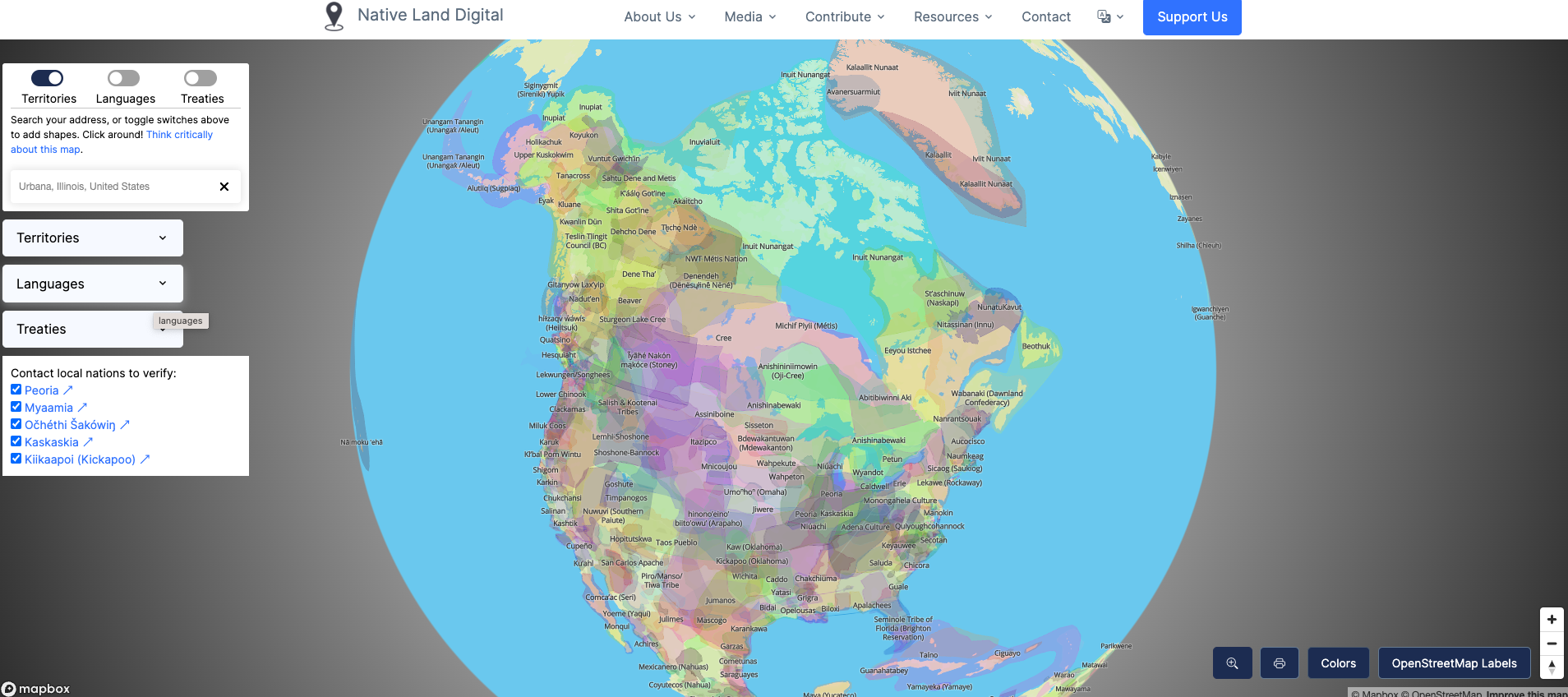
Native Land Digital
Visualizes indigenous lands worldwide, built by a Canadian non-for-profit, that helps us see how this dispossession has shaped our very understanding of geography and political identity.
Native Land Digital
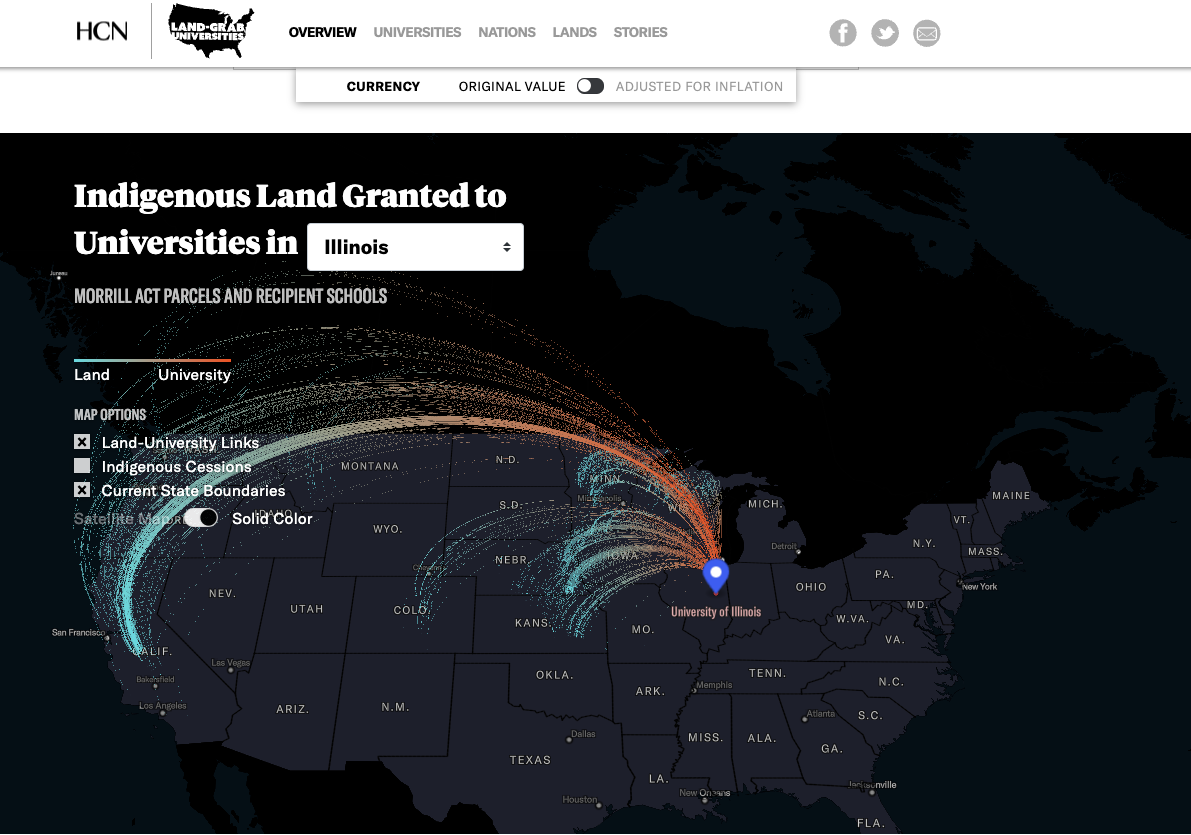
Land Grab Universities
How the Morrill Act dispossessed tribal lands, signed in 1862, dispossessed tribal lands to fund the creation of public state universities. The project was built by Robert Lee, Tristane Ahtone, Margaret Pearce, Kalen Goodluck, Geoff McGhee, and Cody Leff and published by High Country News
Land Grab Universities
Final Discussion Questions
What is computing in the humanities?
What is culture as data?
Visit What is Digital Humanities? and refresh a few times
Also visit Open Syllabus Project