Structuring Unstructured Data: Tokenization, NER & Networks
In the last lesson, we used Pandas string methods to do some initial exploration of the novel texts in our combined dataset — counting characters, searching for patterns, and comparing pronoun frequencies across genres. These methods are fast and useful, but they treat text as a raw sequence of characters rather than as language.
Today we go a step further. We’ll look at what it actually means to structure unstructured text data, starting with the foundational concept of tokenization, then moving to Named Entity Recognition (NER) to extract meaningful entities from our novels, and finally using those entities to build a network that captures relationships between characters across our corpus.
From Structured to Unstructured Data
When we looked at the Top 500 Novels dataset, most of the columns were already structured: genres, rankings, publication years. We could group, filter, and plot them directly. But now that we have the full text of each novel in our eng_text column, we have unstructured data — text that is not easily searchable or analyzable without additional processing.

The challenge of structuring cultural data like this sits at the heart of several overlapping fields:

Rather than trying to define all of text analysis at once, it’s helpful to make a key distinction between two fundamental goals:
Information Retrieval (IR) first developed in the 1950s and 1960s (think Vannevar Bush and the Memex!) and its goal is to find relevant documents for a user’s needs or queries. IR doesn’t necessarily require understanding the content of documents — it can treat them as a “bag of words” and find patterns in word frequencies.
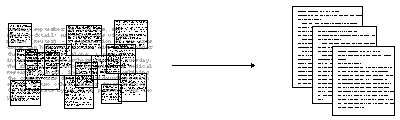
Information Extraction (IE) is different. Rather than finding documents, it extracts specific structured facts from documents — things like who is mentioned, what organizations are named, what events are described. It requires understanding both syntax and semantics.
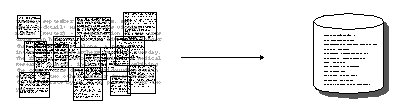
Both approaches require a common first step: tokenization.
Tokenization
Tokenization is the process of breaking text into smaller units called tokens, which can be words, phrases, or characters. Before we can count words, find named entities, or build any model over text, we need to decide how to divide it up.
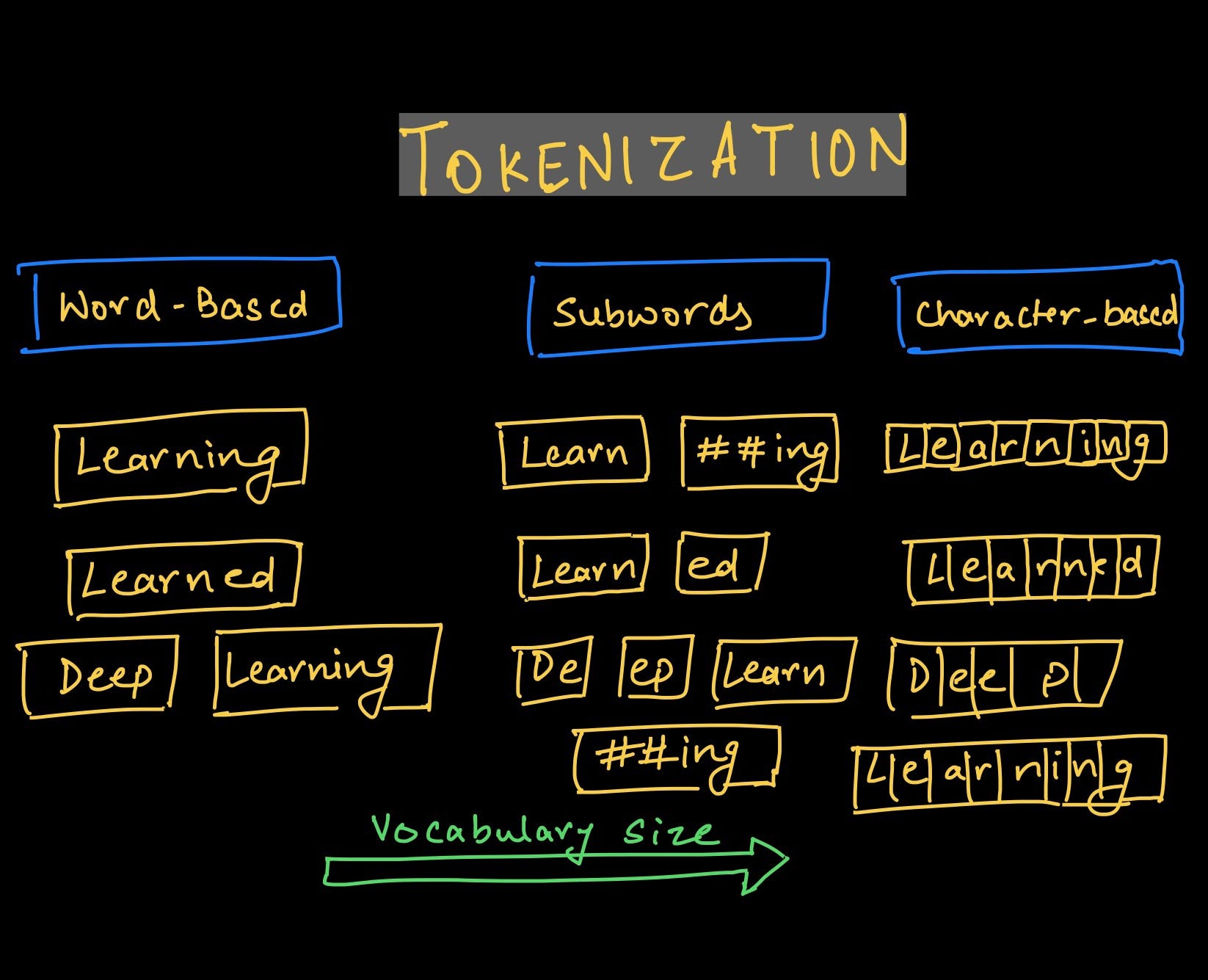
The field of corpus linguistics replaced the informal term “word” with the more precise terms token (a specific occurrence in a text) and type (the abstract word form). For example, “run,” “running,” and “ran” are three different tokens but they all belong to the same type. This distinction matters a lot for analysis.
Why Tokenization Matters: Zipf’s Law
One of the most important scholars in this area was George Zipf, who in the 1930s discovered that in any corpus, the most common word appears roughly twice as often as the second most common, three times as often as the third, and so on. This distribution is known as Zipf’s Law.
Zipf actually discovered this pattern while analyzing James Joyce’s Ulysses — one of the first computational humanities projects! It tells us that a small number of words dominate any text, which has major implications for analysis. When we look at word frequencies, we’ll always see common function words (the, and, of, in) swamping everything else unless we handle them deliberately.
We can explore this with NLTK (remember to pip install nltk):
import pandas as pd
from nltk import word_tokenize, FreqDist

# Load the pre-scraped combined dataset
combined_novels_nyt_df = pd.read_csv("combined_novels_with_text.csv")

# Look at token frequency in the first two novels
tokens = FreqDist(sum(
    combined_novels_nyt_df[0:2]['eng_text'].dropna().map(word_tokenize),
    []
))
tokens.plot(30)
This will show the characteristic “long tail” distribution of Zipf’s Law — a few words with very high frequency, and then a sharp dropoff.
Tokenization Choices Are Interpretive Choices
There is no single “correct” way to tokenize text. Every choice shapes your analysis:
- Lowercasing — should “The” and “the” count as the same token?
- Punctuation — removing it simplifies counting but loses information (question marks, em-dashes)
- Stemming vs. lemmatization — reducing “running” to “run” normalizes forms, but collapses distinctions
- Stop words — common words like “the” and “of” often overwhelm analyses and get removed, but the choice of which words to remove is itself interpretive
- Bigrams — sometimes two-word phrases (“New York”, “not good”) carry more meaning than single tokens
Let’s compare two approaches on our data. First, a simple space-split:
combined_novels_nyt_df['word_count_split'] = combined_novels_nyt_df['eng_text'].str.split().str.len()Then NLTK’s word tokenizer, which is smarter about punctuation and contractions:
def tokenize_text(text):
    if pd.notna(text):
        return word_tokenize(text)
    return []

combined_novels_nyt_df['tokens'] = combined_novels_nyt_df['eng_text'].apply(tokenize_text)
combined_novels_nyt_df['word_count_nltk'] = combined_novels_nyt_df['tokens'].apply(len)

# Compare the two
combined_novels_nyt_df[['title', 'word_count_split', 'word_count_nltk']].head(10)
You’ll find the NLTK counts are slightly higher, because it correctly separates punctuation attached to words (like “said.” becoming “said” and “.”).
Stop Words
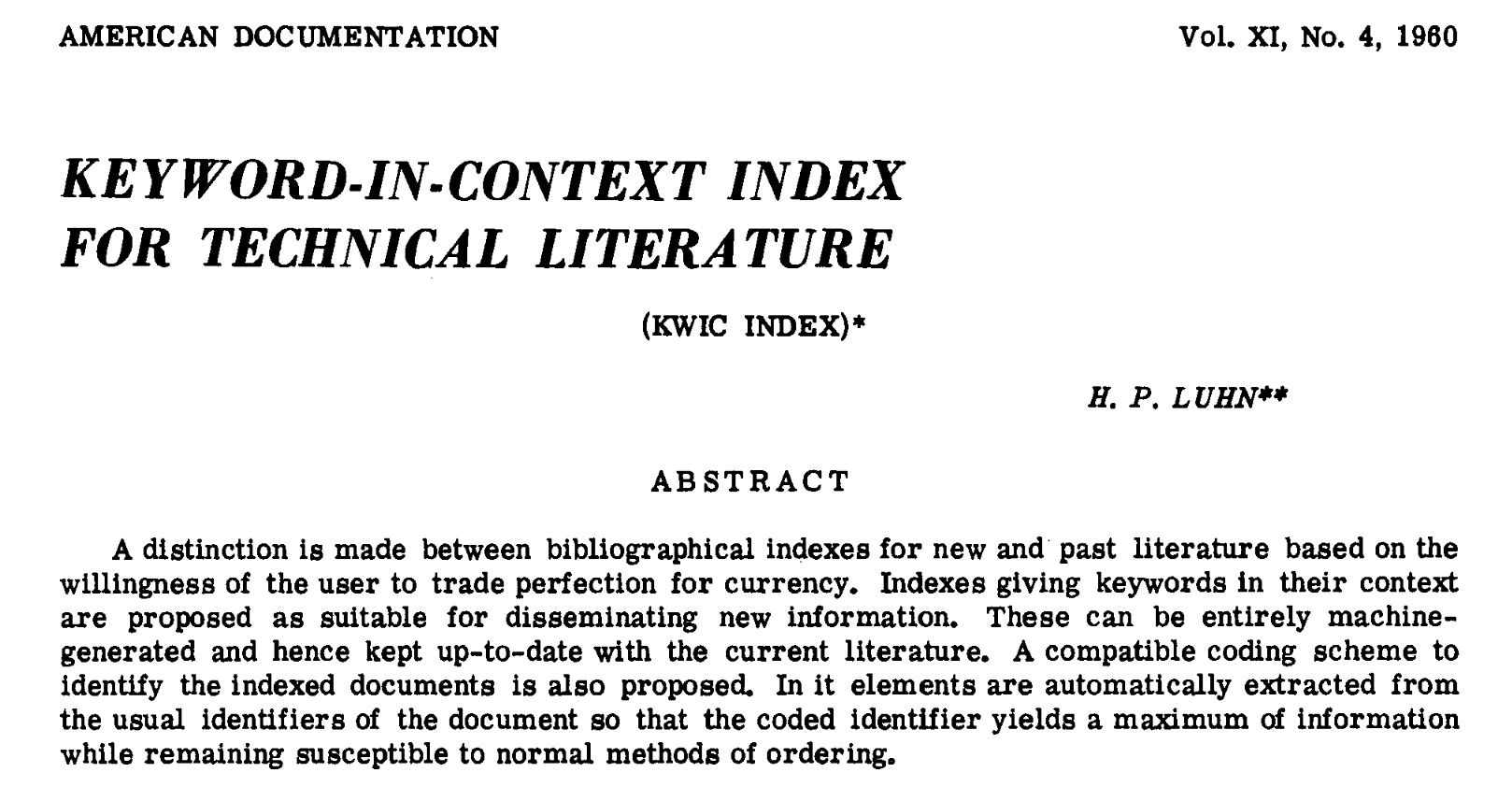
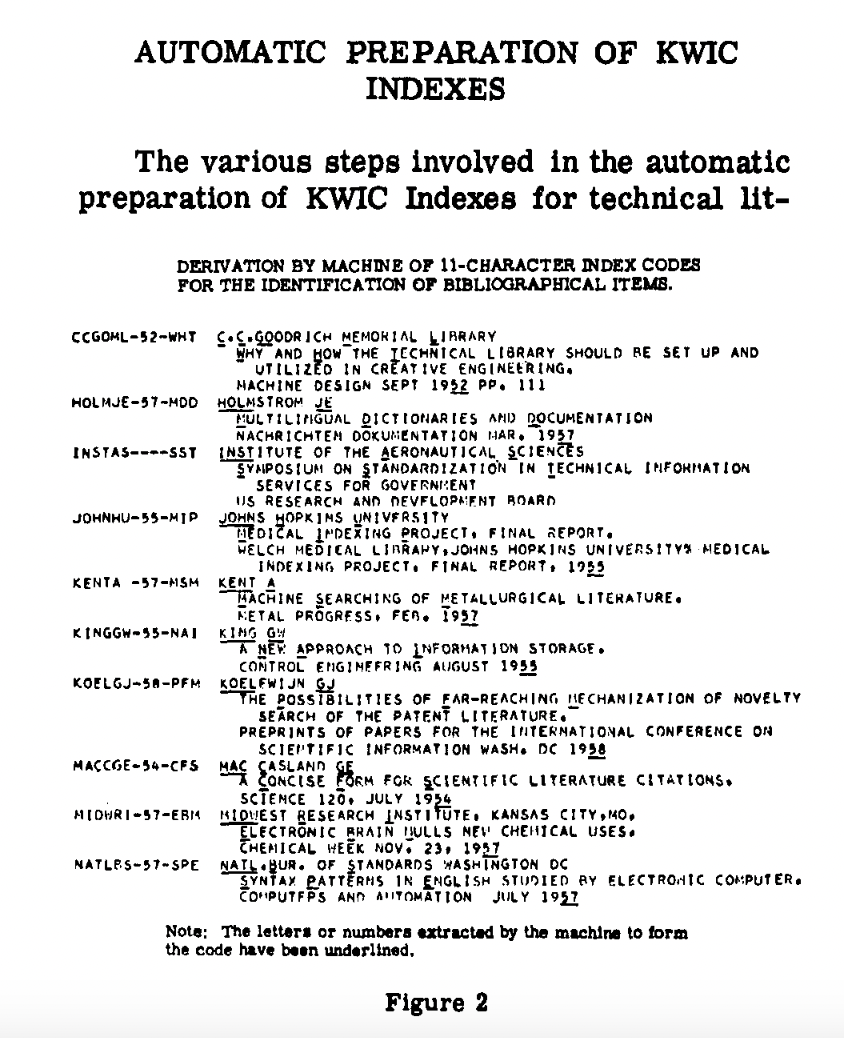
Stop words are the most common words in a language, and they are often removed from text data because they don’t carry much content meaning. The term was coined by Hans Peter Luhn in 1958, when he was developing the concept of Keywords In Context (KWIC) indexing.
|
|
| Images from Luhn, H. P. “Key Word-in-Context Index for Technical Literature (Kwic Index).” American Documentation 11, no. 4 (1960): 288–95. https://doi.org/10.1002/asi.5090110403. | |
NLTK has a built-in stop words list:
from nltk.corpus import stopwords

stop_words = set(stopwords.words('english'))

def remove_stop_words(text):
    if pd.notna(text):
        return ' '.join([w for w in text.split() if w.lower() not in stop_words])
    return text

combined_novels_nyt_df['text_no_stopwords'] = combined_novels_nyt_df['eng_text'].apply(remove_stop_words)
However, this is another interpretive decision. For example, “not” is on the NLTK stop words list, but it’s clearly important for sentiment analysis. We’ve also discussed earlier in the course how crude filtering lists can inadvertently remove content from marginalized communities. Before removing stop words, always inspect the list and consider what you might be losing.
# You can remove specific words from the stop list
stop_words.discard('not')
Named Entity Recognition (NER)
Now that we have a sense of how to structure text at the word level, we can move to something more powerful: extracting named entities — the people, places, organizations, and other specific referents that appear in a text.
From Wikipedia:
“Named-entity recognition (NER) is a subtask of information extraction that seeks to locate and classify named entities mentioned in unstructured text into pre-defined categories such as person names, organizations, locations, medical codes, time expressions, quantities, monetary values, percentages, etc.”

The concept of “named entity” first developed at the Message Understanding Conference-6 in 1995. The field really takes off with the Text Analysis Conferences beginning in 2009 and has since become central to computational humanities — for example, in the Data-Sitters Club article we read, the authors used NER to track character mentions across multilingual translations of The Baby-Sitters Club series.
NER with spaCy
We’ll use spaCy, a powerful and widely used NLP library. First, install it and download the English model:
pip install spacy
python -m spacy download en_core_web_sm
Now let’s load the library and try a quick example:
import spacy
nlp = spacy.load('en_core_web_sm')

doc = nlp("Apple is looking at buying U.K. startup for $1 billion")

for ent in doc.ents:
    print(ent.text, ent.start_char, ent.end_char, ent.label_)
We should see:
Apple 0 5 ORG
U.K. 27 31 GPE
$1 billion 44 54 MONEY
This is telling us the text of the entity, its character positions in the document, and its label. spaCy uses the following entity types among others:

How spaCy Works
spaCy uses a pipeline of statistical models to process text:

The key thing to understand is that spaCy’s NER is based on trained machine learning models — it makes predictions about which label most likely applies based on patterns learned from large annotated datasets. This means it can generalize well to new text, but it also inherits the biases and limitations of its training data.
We can also visualize how spaCy is analyzing a sentence using its built-in displacy visualizer:
from spacy import displacy

doc = nlp("Elizabeth Bennet and Mr. Darcy meet at Netherfield in Hertfordshire.")
displacy.render(doc, style="ent")
Applying NER to Our Novels
Now let’s apply NER to our novel texts. Since spaCy needs to process each text individually, we’ll write a function and use apply():
def get_entities(text, entity_type='PERSON'):
    """Extract all entities of a given type from a text."""
    if pd.notna(text) and len(str(text)) > 0:
        # Limit to first 100,000 characters to keep things fast
        doc = nlp(str(text)[:100000])
        return [ent.text for ent in doc.ents if ent.label_ == entity_type]
    return []

# Extract person entities from each novel
# This will take a few minutes — a good time to grab coffee!
combined_novels_nyt_df['person_entities'] = combined_novels_nyt_df['eng_text'].apply(
    lambda x: get_entities(x, 'PERSON')
)Processing full novel texts through spaCy’s pipeline is slow. For in-class work, it’s fine to limit to the first 100,000 characters of each text, or to work with a small subset of novels. The code above uses that character limit.
Now let’s take a look at what entities were found in a few novels:
for _, row in combined_novels_nyt_df[0:5].iterrows():
    print(f"\n{row['title']} by {row['author']}")
    # Show the 10 most common person entities
    from collections import Counter
    entity_counts = Counter(row['person_entities'])
    print(entity_counts.most_common(10))
You’ll immediately notice something important: spaCy is imperfect. It might tag “Mr.” or “Chapter” as a PERSON, or miss characters referred to only by pronoun. This is a known limitation of statistical NER on literary texts, where characters may be addressed differently throughout a novel (by name, title, nickname, or pronoun). This is exactly the problem the Data-Sitters Club authors grappled with in their multilingual analysis.
Building a Named Entities DataFrame
Rather than keeping entities as lists inside our existing DataFrame, it’s often more useful to create a separate entities DataFrame — one row per entity mention — which we can then analyze and merge back in:
entity_rows = []

for _, row in combined_novels_nyt_df.iterrows():
    for entity in row['person_entities']:
        entity_rows.append({
            'title': row['title'],
            'author': row['author'],
            'genre': row['genre'],
            'pub_year': row['pub_year'],
            'entity': entity
        })

entities_df = pd.DataFrame(entity_rows)
print(entities_df.shape)
entities_df.head(10)
Now we can ask questions like: which person entities appear most frequently across the entire corpus?
entities_df['entity'].value_counts().head(20)Or which entities are most common within each genre?
entities_df.groupby(['genre', 'entity']).size().reset_index(name='count').sort_values('count', ascending=False).groupby('genre').head(5)From NER to Networks
Now we get to one of the most powerful applications of NER: using extracted entities to build a network that represents relationships across a corpus.
The basic idea comes from The Network Turn (which we read earlier in the course): networks are an abstraction that let us represent and compute over relationships between entities. A network has two components:
- Nodes — the entities (in our case, character names)
- Edges — connections between entities (in our case, co-occurrence: two characters appearing in the same novel)
As the authors of The Network Turn note:
Nothing is naturally a network; rather, networks are an abstraction into which we squeeze the world. Nevertheless, almost anything can be turned into a network.
The key interpretive question is: what counts as a relationship? We’ll start with the simplest approach — two characters are “connected” if they both appear in the same novel. Later you might want to use a sliding window approach (characters co-occurring within N words of each other), which captures more local interaction patterns.
Creating a Co-Occurrence Network
Let’s build a network where nodes are the most common named persons across our corpus, and edges connect characters who appear in the same novel.
First, let’s identify the most frequently occurring entities to use as our nodes, filtering out noise:
# Get the top 50 most common entity names across the corpus
top_entities = entities_df['entity'].value_counts().head(50).index.tolist()

# Filter our entities DataFrame to just these
filtered_entities_df = entities_df[entities_df['entity'].isin(top_entities)]
Now we’ll build an edge list. For each novel, any two entities that appear together create an edge (or strengthen an existing one):
from itertools import combinations
import networkx as nx

edge_counts = {}

for title, group in filtered_entities_df.groupby('title'):
    # Get unique entities in this novel
    novel_entities = group['entity'].unique().tolist()
    # Create edges for all pairs
    for entity1, entity2 in combinations(novel_entities, 2):
        pair = tuple(sorted([entity1, entity2]))
        edge_counts[pair] = edge_counts.get(pair, 0) + 1

# Convert to a DataFrame
edges_df = pd.DataFrame(
    [(e1, e2, w) for (e1, e2), w in edge_counts.items()],
    columns=['source', 'target', 'weight']
)

print(f"Number of edges: {len(edges_df)}")
edges_df.sort_values('weight', ascending=False).head(10)
Now we can create a networkx graph from this edge list:
import matplotlib.pyplot as plt

G = nx.from_pandas_edgelist(edges_df, source='source', target='target', edge_attr='weight')

print(f"Nodes: {G.number_of_nodes()}")
print(f"Edges: {G.number_of_edges()}")
Visualizing the Network
plt.figure(figsize=(14, 14))
nx.draw(
    G,
    with_labels=True,
    font_size=8,
    node_size=800,
    node_color='steelblue',
    edge_color='lightgray',
    alpha=0.8
)
plt.title("Character Co-occurrence Network Across Top 500 Novels")
plt.show()
You’ll see a force-directed graph where nodes that are more central tend to be pulled toward the middle. But we can do better than a generic layout — let’s use network algorithms to surface what’s actually interesting.
Network Centrality
Network analysis gives us computational measures of how important each node is. Two of the most useful:
- Degree centrality — how many other nodes does this node connect to? A high degree means an entity co-occurs with many others.
- Betweenness centrality — how often does this node lie on the shortest path between two other nodes? High betweenness means an entity is a “bridge” between otherwise disconnected parts of the network.
degree_centrality = nx.degree_centrality(G)
betweenness_centrality = nx.betweenness_centrality(G)

# Build a summary DataFrame
centrality_df = pd.DataFrame({
    'entity': list(degree_centrality.keys()),
    'degree_centrality': list(degree_centrality.values()),
    'betweenness_centrality': [betweenness_centrality[n] for n in degree_centrality.keys()]
}).sort_values('degree_centrality', ascending=False)

print("Top 10 by Degree Centrality:")
print(centrality_df.head(10))

print("\nTop 10 by Betweenness Centrality:")
print(centrality_df.sort_values('betweenness_centrality', ascending=False).head(10))
The two measures often highlight different entities. A character like “God” might have very high degree centrality (appearing across many novels) but low betweenness centrality (not bridging distinct communities). Conversely, an entity that bridges, say, a cluster of 19th-century novels and a cluster of 20th-century ones might rank highly on betweenness even if it doesn’t appear in that many books.
We can visualize the network with node size proportional to degree centrality:
plt.figure(figsize=(14, 14))
node_sizes = [G.degree(v) * 150 for v in G]
nx.draw(
    G,
    with_labels=True,
    font_size=8,
    node_size=node_sizes,
    node_color='steelblue',
    edge_color='lightgray',
    alpha=0.8
)
plt.title("Character Co-occurrence Network (node size = degree centrality)")
plt.show()
Community Detection
Beyond individual nodes, we can also look for communities — groups of nodes that are more densely connected to each other than to the rest of the network. The Louvain algorithm is a popular method for this:
from networkx.algorithms import community

communities = community.louvain_communities(G, seed=42)

# Map each node to its community number
community_map = {}
for i, com in enumerate(communities):
    for node in com:
        community_map[node] = i

colors = [community_map[node] for node in G.nodes()]

plt.figure(figsize=(14, 14))
nx.draw(
    G,
    node_color=colors,
    with_labels=True,
    font_size=8,
    node_size=800,
    edge_color='lightgray',
    alpha=0.8
)
plt.title("Character Co-occurrence Network with Community Detection")
plt.show()
Each color represents a detected community. Do the communities correspond to anything meaningful — a genre, a time period, a set of canonically linked authors? This is where the computational result becomes a humanities result: the network hands you a pattern, and you have to interpret it.
Interpreting Networks as Cultural Humanists
At this point it’s worth stepping back to think critically about what our network actually represents. The authors of The Network Turn warn us that:
We move across a landscape of abstraction, which entails more information loss the further we travel.
Our network has made several interpretive choices, each of which loses something:
- Entity extraction — spaCy makes errors, especially on literary texts. “Mr.” may be tagged as a person; a character’s nickname may not match their full name.
- Filtering to top entities — by keeping only the 50 most common names, we’ve already shaped what the network can see.
- Co-occurrence at the novel level — two characters are “connected” because they appear in the same book, not because they interact directly. This is a very coarse definition of relationship.
- Treating all co-occurrences as equal — the edge between “Elizabeth” and “Darcy” in Pride and Prejudice carries a very different meaning than two names that both happen to appear in a long Victorian novel.
None of these choices are wrong — they are tradeoffs. The question is whether the pattern that emerges at this level of abstraction is still meaningful for your research question.
One way to improve NER for literary texts is to supplement spaCy’s statistical model with a gazetteer — a pre-compiled list of known entities. For example, if we had a list of character names for each novel, we could add those to spaCy as rules so it always recognizes them correctly. You can read more about this approach in William Mattingly’s textbook http://ner.pythonhumanities.com/02_rules_based_ner.html and the spaCy documentation on the EntityRuler https://spacy.io/api/entityruler.